Showing posts with label peaking. Show all posts

Wednesday, 23 September 2009

Peaking and Tapering, Part III (the triathlete's dilemma)

Having written Part I musing over my taper for Ironman Lake Placid, and Part II about how I was going to fix this problem for Ironman Kona, I recently stumbled upon some important information leading me to post Part III: the triathlete's dilemma. Thanks to the Endurance Nation folks for starting this discussion (maybe it will get moved to a Hall of Fame thread so the public can read it too) and to Russ Cox for helping me out by analysing his own numbers. In fact, I'm looking forward to meeting up with Russ in Kona for an evening of number-crunching geekiness as we try to work out how and why a good taper works.

The dilemma is this: in triathlon, you do three sports. At the Ironman level, I think we can assume most people swim a reasonable amount but not enough to have a severe impact on their training stress. Huge amounts of swimming just aren't a good return on investment for time spent training vs. time gained in the race. So that leaves us with cycling and running. Running tends to be harder on the body, requiring more recovery for most people after intense or long workouts. Cycling can be done in larger volumes and for longer periods at a time, as the impact on the joints is not as great. Thus the fatigue and associated recovery time from running is likely different than the fatigue and recovery from cycling. So the question is, why do we measure ATL (fatigue) on the same scale for both cycling and running? And more importantly, why would you want to pay much attention to a combined Training Stress Balance when that could hide vast differences in fatigue between the two? The answer is, you don't.

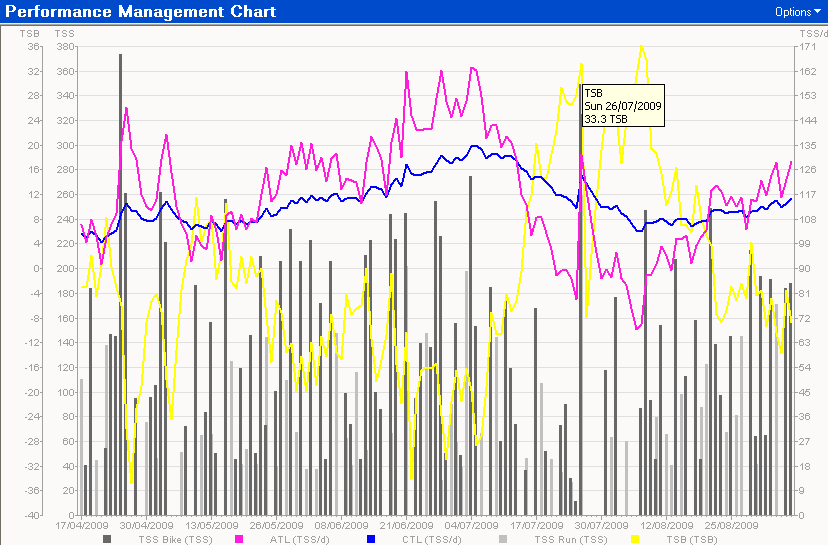
Once I had this "a-ha" moment, I looked back at my IMLP taper and sure enough, my TSB was +33, but that consisted of a bike TSB of +26, while the run TSB was a mere +7. In other words, no wonder my legs felt fatigued out there, my run was not nearly tapered enough! Too much running in the week or two leading up to the race led to this, which was caused by my blindly following my plan without thinking that my mileage up to that point had actually been below what the plan called for. Running 3-4 hours a week in training, then tapering by running 2-3 is not that smart. But low-mileage running is a topic for another post.

I haven't found much information yet on the "ideal" CTL, ATL and TSB numbers for the run vs. the bike in Ironman tapering (though digging through the Google Wattage list and other blogs has got me a bit closer to understanding it), but using Russ's numbers it looks like a run TSB of +15 or so worked for him. I'm aiming for a +12 on race day. I've also adjusted my run ATL to a 10-day constant rather than 7-day as I have on the bike. Wary that I backed off too much on the bike for IMLP, my bike TSB on race day in Kona will be +19 and I'm trying to limit my CTL losses to 13-14%.

See my charts below for the way it's going to look. Note that my TSB will be steadily climbing, rather than seesawing as it did for IMLP, and likewise my ATL and CTL steadily falling. And apologies for mixing and matching Performance Management charts from both SportTracks and WKO+. I finally spent a painstaking evening putting all my workouts between now and Oct. 10 into WKO+ and messing with the length/intensity of each to get what I believe now is a more ideal TSB. So the charts below reveal my new numbers:

run
TSB+12, CTL 37 to 30 for a loss of about 20% (that loss is perhaps still a bit high? but again, my run volume in general has been low compared to the intensity)

bike
TSB +19, CTL 85 to 73 for a loss of about 13-14% (TSB still a bit high, but we'll see how well I acclimatise to the heat and humidity in Hawaii)

total
TSB = +31, CTL 129 to 113 for an overall loss of 12-13%

runPMCedit

bikePMCedit

Thursday, 17 September 2009

Peaking and Tapering, Part II

In Part I, I talked about how (I felt) my taper wasn't quite right for Ironman Lake Placid. I've done more training hours, more consistent training, more intense training and more volume this year than in any year before, so my previous tried-and-true taper method also needed some reworking (it appears). For Ironman Hawaii, I'm going to be a bit stricter on myself in adhering to scheduled workouts in the last few weeks before the race -- both in the sense that I don't overdo it and I don't underdo it -- and hopefully I can have a better race day.

Ultimately, I want to use the Performance Management Chart (PMC) to plan my workouts to help me achieve two things by race day:
1) TBS of about +20
2) CTL loss of about 10% from its highest point.

To this end, the first thing I did was plug my proposed workouts for the next three weeks into SportTracks, along with their projected TSS values. Incidentally I find SportTracks with the Training Load plugin way easier than WKO+ to work with; the calendar makes sense, the notes field lets me add stuff seamlessly, and the general UI and feel of the software is so much more intuitive. And since I'm using TSS/TRIMP values to determine my training load and stress balance (the plugin by default uses HR), the PMC will look the same in WKO+ as in SportTracks -- just nicer. :)

I got my projected TSS values by looking at past similar workouts in WKO+. For instance, I know that a long ride of ~100km/4hrs at an intensity factor of .70 will give me about 200 TSS points. Similarly, an hour-long run including some mile repeats gives me a TSS of 100 or so. Swims I generally use one TSS point per minute, less if I swim easy and more if I swim hard.

Three weeks of workouts, including the final two weeks of peaking/tapering from my Endurance Nation plan, plugged into SportTracks gives me this for my PMC:

PMC
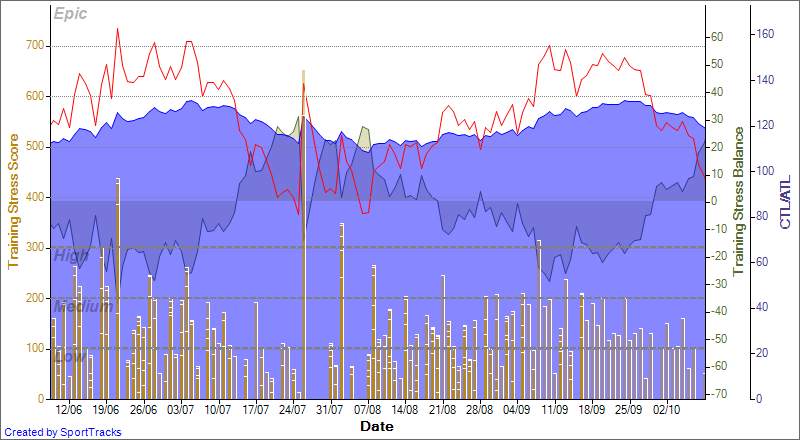
projected CTL/ATL for October 10, 2009

That's a CTL of 119 (down roughly 10% from a projected high of 131 on Sept. 29) and an ATL of 97 to give me a TSB of 22 the day before race day. The TSB is a bit high maybe. But it's also likely that my workouts will feel a bit harder once I get to Kona as I'll need to acclimatise a bit, so having a bit extra on the TSB should be fine. Interesting to compare it to my LP taper (the big drop leading up to July 26) and see how it drops off more gradually and with fewer ATL spikes until the final week.

It's an interesting balance, tapering to shed enough fatigue without losing too much fitness. The problem is, as TSB rises, CTL decreases which can mean more than 10% fitness loss on race day. So which one is more important, keeping to a no-more-than 10% fitness loss, or having a TSB of +20? I think this is probably a problem for most athletes who carry a high CTL: the higher your TSS/day (which is what CTL is), the more you have to do to maintain it. And the more severely you taper and cut your volume, the more CTL drops compared to its absolute highest.

The highly analytical article from Coggan describing the art and science behind the PMC is here, but in my view the most important sentence is this:
in the Performance Manager concept, an individual’s CTL (and the “composition” of the training resulting in that CTL – see more below) determines their performance potential (at least within limits), but their TSB influences their ability to fully express that potential. Their actual performance at any point in time will therefore depend on both their CTL and their TSB, but determining how much emphasis to accord to each is now a matter of trial-and-error/experience, not science.
But I think it's also important to keep in mind what ChuckieV has said about tapering and freshness (though I have to say he loses me with the "anyone training less than 15 hours a week only needs a few days of taper" bit!):
Quite often athletes erroneously aim for being "fresh" when Ironman day arrives, when they really just need to focus on being rested.
Rested is what I'm going to have to be to put on my best performance. That means early to bed every night, naps if I need them, limiting the time spent on my feet doing touristy things and generally staying away from the hustle and bustle of 2000+ other Ironman athletes stressing about their race.

Sunday, 6 September 2009

Peaking and Tapering, Part I

Yesterday I had an enlightening moment reading Joe Friel's blog about Projecting Race Readiness. I had known that my IMLP taper wasn't right, that I had tapered too much and lost too much fitness, resulting in a less-than-ideal race performance, but hadn't really crunched the numbers to see how. I had followed the protocol of 70% of usual volume in the first week of taper, 50% in the second week, 30% in the third week. Still, I felt flat and underpowered on race day and terrible compared to last year at Ironman Germany where I had tapered so carefully and hit race day feeling great.

Two things stood out for me in particular from Joe's post:
1. Training Stress Balance (TSB, or CTL minus ATL) should be about +20 by race day.
2. Total loss of Chronic Training Load (CTL, aka fitness) should be kept to about 10%.

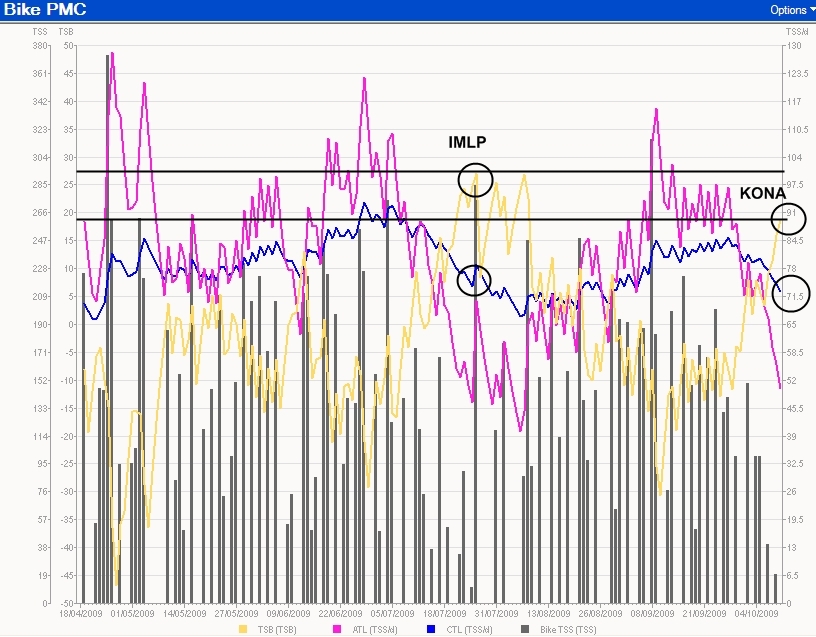
I had a look at my own Performance Management Chart from WKO+ and checked out the numbers. Sure enough, between my taper start date of July 5 and race date of July 26, my CTL (blue line) had gone from 133 to 112, a 15% drop. And my TSB (yellow line) was over 30, way too high! Ironically, being more "rested" through a lower ATL (red line, aka fatigue) and higher TSB is the very thing that helped me feel slow and tired and flat during the race.

Tapering is certainly part art, part science, and there are a lot of factors that could have affected my race day readiness in Lake Placid. But from studying my data below, I can see clearly now how my drastically reduced training load -- too much too soon -- nearly blew my race though a poorly-executed peak period and taper.

PMC
How not to peak/taper

In Part II I'll take a stab at describing what my peak period and taper for Kona should look like, and what I'll do differently to achieve it (and in doing so, hopefully achieve a better race day freshness than I did at Lake Placid).

If you're not familiar with WKO+ and all the terms I've used, here's a basic crash course.