Showing posts with label Coggan. Show all posts

Sunday, 25 April 2010

FTP and the 25-mile TT benchmark

Today I completed my second ever 25-mile time trial on the roundabout-filled and rolling G53/25 course. This is an interesting distance to race due to its association with that hallmark measurement of fitness and performance: FTP or functional threshold power. With the advent of powermeters on bikes, someone decided that the power you can put out for approximately an hour (coincidentally the length of time a 25-mile or 40km TT lasts for a reasonably fit rider) should be the benchmark for measuring all other power outputs. Thus, all other performance and fitness factors are a function of that one-hour power, with paces and levels described as a percentage of FTP. So a Training Stress Score (TSS) of 100 is defined as one hour at FTP, and an Intensity Factor (IF) of 1.0 is when your power output is 100% FTP.

I've often thought about whether this system of testing and evaluation power is really accurate for most riders, since few of us ride 60 minutes at a steady state in an all-out effort very often. Yet this magical number is how I and WKO measure my effort and fatigue from all other workouts, both short and long. I suppose it's like anything: you need to train it to be good at it, so if I actually did lots of steady-state intervals at FTP like Coggan suggests, maybe my one-hour power would reflect that. But since I don't, I've had to use other measures to figure out my FTP. And it turns out that the FTP I've been using to define my training is actually a bit lower than what I can actually put out for a 25 mile time trial.

Last autumn when I did my 25 mile TT for the first time, I had my FTP set at 240 watts. This was based on a number of races I had done, intervals I could hold in training, etc. I showed up at the TT on the knife edge of fatigue, merely a few weeks before Kona. And managed to put down a time of 1:00:49 with 221 watts normative power, 218 watts average power. A full 15 watts fewer than I "should" have been able to do! Hmm.

I don't think I overestimated my FTP too much, maybe by 5 watts or so. A few weeks earlier I had done a 10-mile TT (~105% of FTP) on 254 watts so had based my numbers in part on that. Had I been fully rested, I might have been able to hit that 240 watts, or had I been doing Olympic distance triathlon training instead of Ironman, or, or, or... anyway, suffice it to say, I let my fitness tail off after Kona and at Christmas I was back down to an estimated FTP of 220 watts, to be built back up between January and March via cyclocross, winter circuit races and a warm-weather training camp spent on the Canary Islands.

Today I showed up -- same course, same time of day, same air temperature and conditions more or less, same equipment more or less, same lack of sleep, though I was less fatigued overall -- and put down a 1:01:59 with 225 watts normative power and 223 watts average power. The rain halfway through and subsequent windier conditions probably was the biggest factor in the slower time (the winner of both races who happened to be the same guy was also 90 seconds slower), though I also wriggled around a lot and cost myself some aerodynamic advantage, having not ridden my TT bike in a while and not being entirely comfortable on it. Yet I still fell 10 watts short of my current estimated FTP, which is set at 235 watts these days and I think is pretty close to reality.

No excuses this time (apart from the wriggling), but again it leaves me wondering who out there can actually ride 60 minutes straight at a completely steady effort at their WKO-estimated FTP. Yes, I could set my FTP lower, but then all my other intervals -- particularly the shorter ones -- would be overestimated, thus inflating my IF and TSS for every other workout. So this is the flaw in WKO+ I think: basically your single biggest benchmark by which all effort is measured is somewhat impossible to actually achieve! Unless of couse you race 25 mile TTs all the time. Does anyone else have this problem?

At any rate I was pleased to see an overall increase in today's race of 5 watts over last time, meaning that my fitness is pretty much at the same place it was last September when I was peaking for Ironman Kona. And it's still April! Lots of summer racing to come. For future FTP tests I'll be more likely to go out and do a Richmond Park 3LC some nice evening. Same ~60-min effort and a lot closer to home!

Below is a graphical comparison of the September 2009 and April 2010 time trials (the grid line shows the average watts for each race). Both were paced reasonably well, both contained an obvious dip halfway through as I felt the effects of the effort, and both started out perhaps a bit strongly. Today's effort showed a better recovery and kick through the last quarter of the race, and also shows how much less fatigued my overall state was, with an average HR of nearly 10 beats higher! Otherwise, the slower speeds on the downhills show the headwind today; you'd never know I had a disc cover on there.
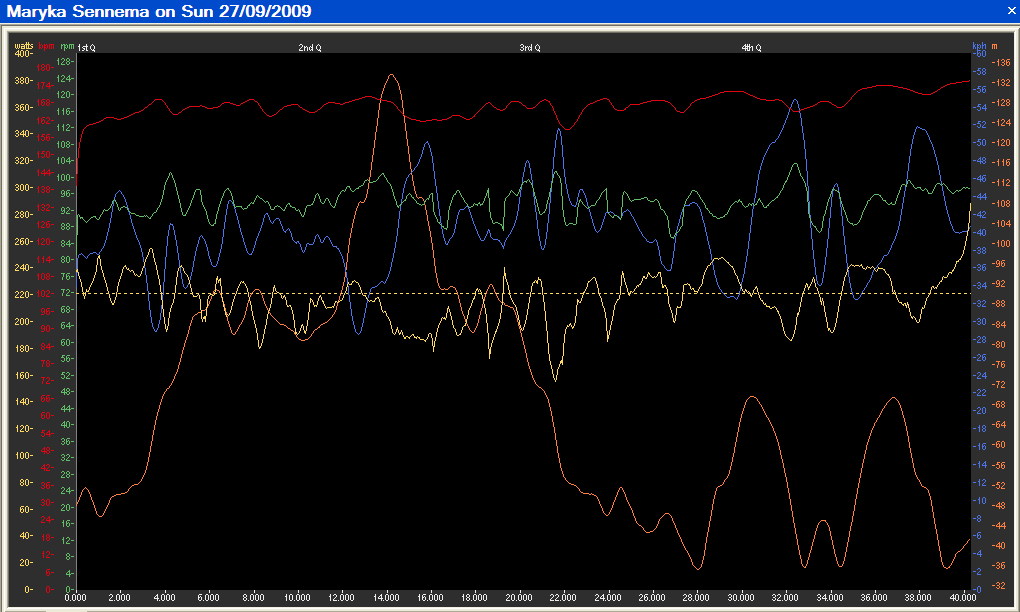

200909TT

September 27, 2009
Lap 1 (1:00:49.15):
Duration: 1:00:49 (1:00:57)
Work: 796 kJ
TSS: 85.9 (intensity factor 0.921)
Norm Power: 221
VI: 1.01
Pw:HR: -0.28%
Pa:HR: -4.76%
Distance: 40.329 km
Elevation Gain: 412 m
Elevation Loss: 417 m
Grade: -0.0 % (-5 m)
Min Max Avg
Power: 0 389 218 watts
Heart Rate: 98 176 167 bpm
Cadence: 47 131 94 rpm
Speed: 0.3 57.4 39.8 kph
Altitude: 32 137 69 m
Crank Torque: 0 60.9 22.2 N-m
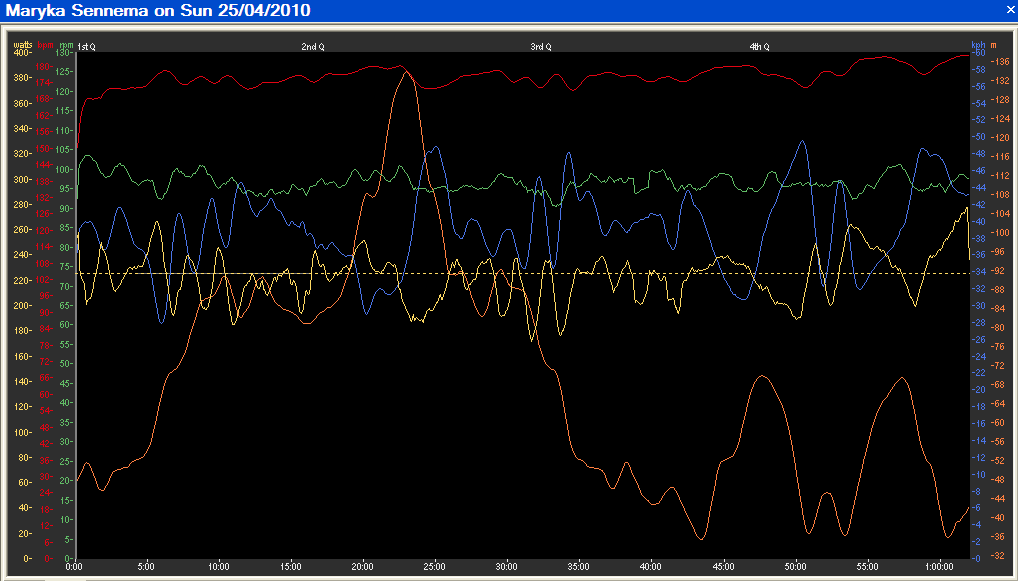


201004TT

April 25, 2010
Lap 1 (1:01:58.01):
Duration: 1:01:58 (1:02:06)
Work: 828 kJ
TSS: 95 (intensity factor 0.959)
Norm Power: 225
VI: 1.01
Pw:HR: 0.75%
Pa:HR: -2.91%
Distance: 40.35 km
Elevation Gain: 417 m
Elevation Loss: 421 m
Grade: -0.0 % (-5 m)
Min Max Avg
Power: 0 656 223 watts
Heart Rate: 117 184 176 bpm
Cadence: 53 123 97 rpm
Speed: 1.4 59.1 39.1 kph
Altitude: 32 137 69 m
Crank Torque: 0 103.2 22.0 N-m

Thursday, 17 September 2009

Peaking and Tapering, Part II

In Part I, I talked about how (I felt) my taper wasn't quite right for Ironman Lake Placid. I've done more training hours, more consistent training, more intense training and more volume this year than in any year before, so my previous tried-and-true taper method also needed some reworking (it appears). For Ironman Hawaii, I'm going to be a bit stricter on myself in adhering to scheduled workouts in the last few weeks before the race -- both in the sense that I don't overdo it and I don't underdo it -- and hopefully I can have a better race day.

Ultimately, I want to use the Performance Management Chart (PMC) to plan my workouts to help me achieve two things by race day:
1) TBS of about +20
2) CTL loss of about 10% from its highest point.

To this end, the first thing I did was plug my proposed workouts for the next three weeks into SportTracks, along with their projected TSS values. Incidentally I find SportTracks with the Training Load plugin way easier than WKO+ to work with; the calendar makes sense, the notes field lets me add stuff seamlessly, and the general UI and feel of the software is so much more intuitive. And since I'm using TSS/TRIMP values to determine my training load and stress balance (the plugin by default uses HR), the PMC will look the same in WKO+ as in SportTracks -- just nicer. :)

I got my projected TSS values by looking at past similar workouts in WKO+. For instance, I know that a long ride of ~100km/4hrs at an intensity factor of .70 will give me about 200 TSS points. Similarly, an hour-long run including some mile repeats gives me a TSS of 100 or so. Swims I generally use one TSS point per minute, less if I swim easy and more if I swim hard.

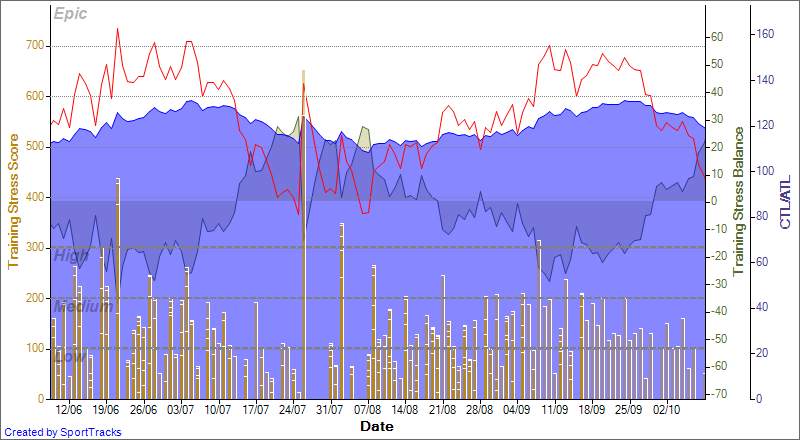
Three weeks of workouts, including the final two weeks of peaking/tapering from my Endurance Nation plan, plugged into SportTracks gives me this for my PMC:

PMC
projected CTL/ATL for October 10, 2009

That's a CTL of 119 (down roughly 10% from a projected high of 131 on Sept. 29) and an ATL of 97 to give me a TSB of 22 the day before race day. The TSB is a bit high maybe. But it's also likely that my workouts will feel a bit harder once I get to Kona as I'll need to acclimatise a bit, so having a bit extra on the TSB should be fine. Interesting to compare it to my LP taper (the big drop leading up to July 26) and see how it drops off more gradually and with fewer ATL spikes until the final week.

It's an interesting balance, tapering to shed enough fatigue without losing too much fitness. The problem is, as TSB rises, CTL decreases which can mean more than 10% fitness loss on race day. So which one is more important, keeping to a no-more-than 10% fitness loss, or having a TSB of +20? I think this is probably a problem for most athletes who carry a high CTL: the higher your TSS/day (which is what CTL is), the more you have to do to maintain it. And the more severely you taper and cut your volume, the more CTL drops compared to its absolute highest.

The highly analytical article from Coggan describing the art and science behind the PMC is here, but in my view the most important sentence is this:
in the Performance Manager concept, an individual’s CTL (and the “composition” of the training resulting in that CTL – see more below) determines their performance potential (at least within limits), but their TSB influences their ability to fully express that potential. Their actual performance at any point in time will therefore depend on both their CTL and their TSB, but determining how much emphasis to accord to each is now a matter of trial-and-error/experience, not science.
But I think it's also important to keep in mind what ChuckieV has said about tapering and freshness (though I have to say he loses me with the "anyone training less than 15 hours a week only needs a few days of taper" bit!):
Quite often athletes erroneously aim for being "fresh" when Ironman day arrives, when they really just need to focus on being rested.
Rested is what I'm going to have to be to put on my best performance. That means early to bed every night, naps if I need them, limiting the time spent on my feet doing touristy things and generally staying away from the hustle and bustle of 2000+ other Ironman athletes stressing about their race.

Thursday, 13 August 2009

Crystal Palace

DSC_0390
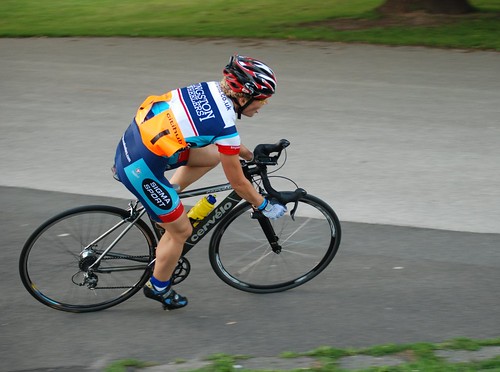
Watch that pedal strike (and the tongue won't help in a crash!)

In my quest to get enough points for cat 2 and to visit all the race circuits around London in the meantime, I headed to Crystal Palace on Tuesday evening for their weekly race. It's by far the best atmosphere I've seen yet for a cycle race: lots of folks on the grass lounging around and chatting, a course that only takes about two minutes to ride per lap, and sunny weather that's the requirement for the race to run (too slippery and dangerous if it's raining). Apparently the women's race tends to attract pretty low numbers, so it was nice to see a dozen of us on such a beautiful late summer evening lining up at the start.

DSC_0365
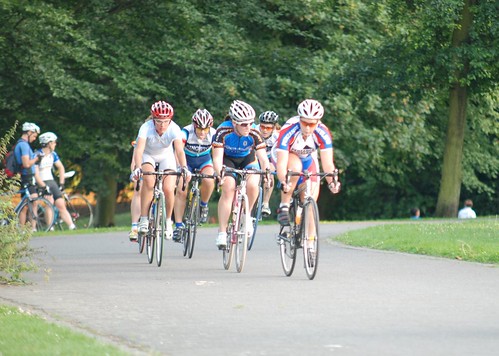
Early on and we're already chasing escapees

The Palace is more crit-like than any other circuit I've raced, save the Nocturne: a 1.3km course consisting of a 50-metre straightaway after the start, then a sharp 180-degree turn, a quick little twisty downhill, a long 180 degree corner, and a draggy uphill before a flat finish. The course is wide enough to allow overtaking, though with three groups racing (women's, men's cat 3/4, and men's cat E/1/2) it can be a little crowded at times -- as evidenced by the guy who swung wide into me on the corner and hit my front wheel, nearly taking me out! But as I proved at the Smithfield Nocturne, my cornering is pretty awful, and my descending and cornering combined is even worse, so even though I'd ridden a few laps in warm-up, I had no doubt that I wouldn't be going off the front anytime soon, if ever. And in 23 laps at Crystal Palace, I swear the lap counter said 14 before I even felt comfortable in the drops, not braking, and managing to lean my bike into the turns! The good news is that by the end, I sort of had it worked out, though I had to keep shouting to myself "lean! lean!" on every lap and focussing on weighting my right leg as much as I could for those left-hand bends. But for my first time at the Palace, I wasn't disappointed with how I rode.

DSC_0447
Following Rachel's line, I'm getting better at the lean

I'd read some other reports of how this race usually goes down -- a strong rider goes from the off and manages to stay away the whole race -- but with Charlie Blackman out of town, it was going to fall to someone else this time. I thought, "if only I can keep her in sight, whoever she is, til my legs come around in the second half, then maybe we have a chance to get some ground back." Little did I know the effect the men's race overtaking us every 7-8 laps would have. Basically I learned from the wrong end the prime rule for racing at the Palace if you're in the women's race: get a bit of a gap, hold it as best you can, let the draft from the overtaking men's races give you a little boost to get even further ahead, then repeat seven laps later. Not sitting on wheels, mind you (that's not allowed), but just using that massive pack of guys to disappear from the sight of the women chasing you. I must admit I tried to do that myself when the guys came around -- use them to get a bit more speed and momentum to make catching our ladies' break easier -- but by then it was too late. If someone's away by the time the guys come around the first time, you can pretty much plan to see her at the finish line unless she either punctures or blows up.

DSC_0377
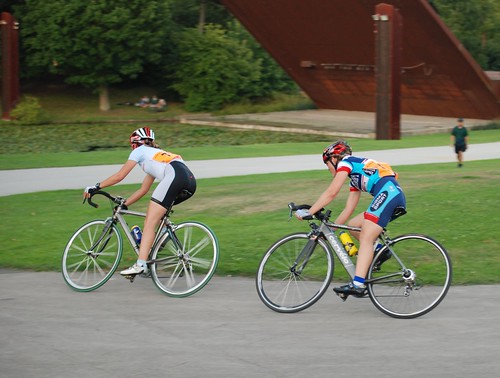
Trying not to lose touch on the downhill


DSC_0411
The effort is starting to show for all of us

DSC_0367
Is that a grimace?

Still, a race at the Palace turned out to be the best 51-minute workout I could have asked for. Once I settled in (took me a good half-hour as usual -- and I'd ridden an hour to the race as warm-up!) I sat a lot on the front and drove the pace up the hill in particular. One of the two girls who went off the front was brought back; the other was too strong. I didn't trust my legs to try to get away myself, so I just worked hard and brought our group of 11 down to six by the finish. My teammate Leona and I -- both of us never having raced there before -- didn't have any kind of plan, so it came down to a bunch sprint. I knew that there'd be at least one person trying to come around and outsprint me at the finish, and given my awful acceleration and sprint power, I knew I had to use my head instead of my legs. Coming up the final hill, I was caning it quite hard but eased off just before the top, thinking I could jump on the inevitable wheel when it came around, but I mistimed it and she was by me before I knew it. A valiant effort to get on her wheel, but I ran out of road and finished a bike length behind, 3rd place overall.

Leona and I both have rental powermeters on our road bikes so we've been comparing power data lately. We're about the same weight, though she's taller and younger and I've been cycling for longer. Still, thanks to Leona's recent push into training and racing hard, we're remarkably close: FTP, top-end watts, even heart rate. It's interesting to break down the differences in our Crystal Palace race.

Maryka
Entire workout (207 watts):
Duration: 51:29 (51:33)
Work: 640 kJ
TSS: 85 (intensity factor 0.996)
Norm Power: 234
VI: 1.13
Pw:HR: 5.2%
Pa:HR: 3.09%
Distance: 30.413 km
Elevation Gain: 683 m
Elevation Loss: 682 m
Grade: 0.0 % (1 m)
Min Max Avg
Power: 0 678 207 watts
Heart Rate: 123 187 175 bpm
Cadence: 38 170 101 rpm
Speed: 0 60.9 35.4 kph
Pace 0:59 0:00 1:42 min/km
Altitude: 73 99 87 m
Crank Torque: 0 89.7 19.3 N-m

Leona
Entire workout (204 watts):
Duration: 51:32 (52:41)
Work: 630 kJ
TSS: 94.9 (intensity factor 1.051)
Norm Power: 231
VI: 1.14
Pw:HR: 5.25%
Pa:HR: 1.58%
Distance: 19.018 mi
Elevation Gain: 1504 ft
Elevation Loss: 1467 ft
Grade: 0.0 % (38 ft)
Min Max Avg
Power: 0 624 204 watts
Heart Rate: 117 188 175 bpm
Cadence: 31 182 91 rpm
Speed: 4.6 41.4 22.1 mph
Pace 1:27 13:03 2:43 min/mi
Altitude: 219 303 266 ft
Crank Torque: 0 1303 187 lb-in


-- FTP: judging from this race, I think Leona's FTP is probably higher than the 220 she's got in WKO+. In fact, given that Crystal Palace is the kind of course where you don't get much rest (sprinting out of corners, riding uphill, even blasting downhill to catch up to faster descenders), I'd say that if we'd ridden another 9 minutes to bring the race to one hour, her NP wouldn't have been much lower than 231. My tested FTP on my road bike is 235, and both my perceived exertion in the race and the numbers show that that figure is probably still about right.

-- Work: according to the kJ spent by each of us, I did more "work" per se, even though the overall training stress score (TSS) for me is lower than for Leona. This is because TSS is directly related to FTP -- the higher the FTP, the lower the TSS for the same training session, all other things being equal. The reason I burned more kJ is because I sat on the front of the group more and didn't draft as much behind other riders.

-- zero watts: what you can't see in the data summary above is how much time we both spent freewheeling, or producing fewer than 20 watts. According to Coggan and Allen's book, "most winning road racers do not pedal at least 15 percent of the time". Looking at our cadence distribution charts, I pedalled for 86% of the race at Crystal Palace, but Leona managed to pedal only 80% of the time. Again, this shows how much she was drafting and how much I wasn't -- and in fact, how much smarter she raced because of it! Maybe if I'd pedalled less, drafted and conserved more, especially in the last lap or two, I would have been the one coming around the others to sprint to the win. Or maybe not...

In any case, both Leona and I are signed up for a men's cat 3 race this coming weekend (Jim and a bunch of other Kingston Wheelers will join us), and you can bet that both of us will be doing as little work as possible!

Wednesday, 22 April 2009

A tale of two races


Sid Standard Memorial Race

Having had a little break from cycle racing the past few weeks for the marathon, I was eager to get back to it. Last week my monster 15 hours spent training (but the weather's just been too nice not to get out there and ride!) meant that Sunday's National Women's Team Series race just outside Nottingham would be an interesting test of the legs. As a member of the Surrey League ladies team, I was racing with a handful of other women from local clubs -- all of whom, like me, don't have enough teammates to put together their own teams -- for the first time this season. It's a team series, meaning that the top 4 results per team count toward the points ranking, and the final trophy goes to the winningest team rather than an individual (though each race rewards individual winners too of course).

The race started out fast with several riders on the front (most notably elite rider Charlie Blackman of the London Dynamo) driving the pace and controlling the attacks, but after four laps when it appeared that no cohesive break would stay away and the bunch was whittled down to 30 or so riders, things settled down a bit. On the sixth lap as we approached the main climb on the course, a little 500m 3% affair, I found myself at the front and decided to take a run at it and see what happened. I hit the climb hard and didn't look back til I got to the top -- much to my surprise, the bunch was more than 50 metres behind me! Unfortunately I was now descending into a crosswind so I tucked down and did my best, but after 2km the bunch came back (note to self for next time: if the motorcycle pulls in front of you, you've been caught and can stop working now).

The legs felt good though, almost like that little super-threshold effort woke them up, so I stayed near the front of the remainder of the race, hoping a late break would still materialise. My teammate Jen Hewitt had a few digs, as did some other riders, but again nothing stuck. So the flat finish meant a bunch sprint, where my skills are not particularly well-suited. Being a bit scared off by the argy-bargy and generally poor bike handling of the field in the final lap, I did not try to contest the sprint and instead just stayed safely out of trouble, finishing 23rd overall. The race was won by Laura Trott, the up-and-coming and talented junior who placed quite well at the recent KW Dunsfold 3rd cat road race. I discovered one of my teammates, Nikki Wheeler, can put in a sprint, so next time I'll know to try and help her out better if it comes down to a bunch finish. The photo above of Jen on the front with me a ways back in the bunch (both of us in white jerseys) is a pretty typical view of the Sid Standard race. The British Cycling write-up, where we both earned a nice mention despite finishing outside the top 20, is here.

But the truth is, for me to have any success at women's racing (or any racing for that matter), I need to create, join, or force a break to happen -- not solo! -- so I can put my ability to suffer at threshold for a long time to good use. Looking at my power profile according to Coggan, my five-second peak power is the equivalent of a lowly cat 4, and at one and five minutes I'm only a bit better at mid cat 2 level. It's power at FT where I'm strongest, as I'm putting out ~230 watts with my 54kg, making me a 4.25watts/kg solid cat 1 equivalent. And given what seems to be some hill climbing ability on steeper grades, I think I need to find some hillier races with better prospects for a break escaping and staying away til the finish. (As an aside, now that we've got our new Powertaps, I need to do another round of testing to make these numbers a little more firm and set myself some goals.)


Hillingdon Tuesday Night Series

Jim's been wanting to do some more racing, so despite a nice steady 90km ride on Monday afternoon that left our legs a bit tired, last night we headed over to the Hillingdon summer series (my favourite local circuit of all that I've raced so far) to take on the cat 4 race. I had been playing with the idea of entering the E/1/2/3 race as there's a £15 prize for the top female finisher, but once I got there and saw a) how huge the sign-on list already was, b) a well-known pro men's team warming up, and c) women's pro rider Leda Cox who would undoubtably take the prize money, I wisely decided that the cat 4 race was the way to go. And that way Jim and I could race together, a first!

All was going well, with both of us in the front 5-10 riders for most of the race. I had gone off at a good pace almost immediately, as the bunch had started so slowly that I feared a massive acceleration where I would not be able to grab a wheel, and ended up leading most of the first lap. Then the attacks started, but with a headwind going up the hill and a tailwind coming down the back straight, conditions were not great for a solo break to last. Jim bridged to (or chased down, depending on how you saw it) a London Dynamo rider but that didn't last, and he ended up on the front as the E/1/2/3 race stormed by. A few other guys put in some digs and the bunch always collected them back into the fold after half a lap or so. The E/1/2/3s passed us once again, rather scarily through the hairpin turns where a lot of riders have difficulty holding a line, but everyone made it through safely.

Around 15 laps into it, I put in some effort latching onto escaping riders, thinking that even though the sun was setting, there was a lot of time left in this one-hour race. That cost me as I had
slipped back to 15-20th place by the time we got to the lap board, and stupidly failed to notice that we were heading for the bell lap til the bell was actually ringing. Well out of position to do anything in the final lap, I tried valiantly to move up on the back stretch and nearly did it on the final corner, til the wheel I was following sat up and stopped working. Alas, unless I'm in the top 5 or so coming around that corner, I just don't have the power to put in a strong finish against the guys, so even though I got around him and got some speed up for the little climb, it was too late. To add insult to injury, some well-meaning guy who was determined to get 19th instead of 20th place muscled me over towards the grass in the final chicane, killing all my speed.

At that moment, I could see Jim ahead who was in a better position for the final sprint, but then a massive crash took down four guys right in front of him, so I slowed up completely and just rolled across the line (after I had a close look at the four downed riders and determined with relief that he wasn't one of them!) The crash looked nasty and I think one of the guys involved was a Twickenham rider that I'd already shouted at twice during the race to hold his line (the second time after he'd been weaving all over the back straight in an attempt not to do any work on the front and get people to come around him). Jim had to lean into a rider next to him to avoid riding over one of the downed rider's heads, but he stayed upright himself, though his sprint was finished.

I'm a bit annoyed with myself for missing the lap boards and losing focus right at the moment when I needed it the most, but given the crash, maybe I'm glad to have been in the back half of the pack towards the finish. It didn't look good and an ambulance with flashing lights turned into Springfield Rd as we were riding home, presumably to collect one of the victims. That's about the 3rd or 4th race I've done at Hillingdon that contained an ambulance-worthy crash, and I've only raced there 5 times! I wonder how long til the law of averages gets me. I definitely wish it could have been longer as my legs felt great and longer races suit me anyway. As it was, the one-hour came up a bit short, only 42 minutes which was about 17 laps, 38.6km/h avg speed.

I think some of the riders in our race could learn a thing or two from these guys on how to hold a line going up the final hill...