Showing posts with label IMLP. Show all posts

Wednesday, 23 September 2009

Peaking and Tapering, Part III (the triathlete's dilemma)

Having written Part I musing over my taper for Ironman Lake Placid, and Part II about how I was going to fix this problem for Ironman Kona, I recently stumbled upon some important information leading me to post Part III: the triathlete's dilemma. Thanks to the Endurance Nation folks for starting this discussion (maybe it will get moved to a Hall of Fame thread so the public can read it too) and to Russ Cox for helping me out by analysing his own numbers. In fact, I'm looking forward to meeting up with Russ in Kona for an evening of number-crunching geekiness as we try to work out how and why a good taper works.

The dilemma is this: in triathlon, you do three sports. At the Ironman level, I think we can assume most people swim a reasonable amount but not enough to have a severe impact on their training stress. Huge amounts of swimming just aren't a good return on investment for time spent training vs. time gained in the race. So that leaves us with cycling and running. Running tends to be harder on the body, requiring more recovery for most people after intense or long workouts. Cycling can be done in larger volumes and for longer periods at a time, as the impact on the joints is not as great. Thus the fatigue and associated recovery time from running is likely different than the fatigue and recovery from cycling. So the question is, why do we measure ATL (fatigue) on the same scale for both cycling and running? And more importantly, why would you want to pay much attention to a combined Training Stress Balance when that could hide vast differences in fatigue between the two? The answer is, you don't.

Once I had this "a-ha" moment, I looked back at my IMLP taper and sure enough, my TSB was +33, but that consisted of a bike TSB of +26, while the run TSB was a mere +7. In other words, no wonder my legs felt fatigued out there, my run was not nearly tapered enough! Too much running in the week or two leading up to the race led to this, which was caused by my blindly following my plan without thinking that my mileage up to that point had actually been below what the plan called for. Running 3-4 hours a week in training, then tapering by running 2-3 is not that smart. But low-mileage running is a topic for another post.

I haven't found much information yet on the "ideal" CTL, ATL and TSB numbers for the run vs. the bike in Ironman tapering (though digging through the Google Wattage list and other blogs has got me a bit closer to understanding it), but using Russ's numbers it looks like a run TSB of +15 or so worked for him. I'm aiming for a +12 on race day. I've also adjusted my run ATL to a 10-day constant rather than 7-day as I have on the bike. Wary that I backed off too much on the bike for IMLP, my bike TSB on race day in Kona will be +19 and I'm trying to limit my CTL losses to 13-14%.

See my charts below for the way it's going to look. Note that my TSB will be steadily climbing, rather than seesawing as it did for IMLP, and likewise my ATL and CTL steadily falling. And apologies for mixing and matching Performance Management charts from both SportTracks and WKO+. I finally spent a painstaking evening putting all my workouts between now and Oct. 10 into WKO+ and messing with the length/intensity of each to get what I believe now is a more ideal TSB. So the charts below reveal my new numbers:

run
TSB+12, CTL 37 to 30 for a loss of about 20% (that loss is perhaps still a bit high? but again, my run volume in general has been low compared to the intensity)

bike
TSB +19, CTL 85 to 73 for a loss of about 13-14% (TSB still a bit high, but we'll see how well I acclimatise to the heat and humidity in Hawaii)

total
TSB = +31, CTL 129 to 113 for an overall loss of 12-13%

runPMCedit

bikePMCedit

Sunday, 6 September 2009

Peaking and Tapering, Part I

Yesterday I had an enlightening moment reading Joe Friel's blog about Projecting Race Readiness. I had known that my IMLP taper wasn't right, that I had tapered too much and lost too much fitness, resulting in a less-than-ideal race performance, but hadn't really crunched the numbers to see how. I had followed the protocol of 70% of usual volume in the first week of taper, 50% in the second week, 30% in the third week. Still, I felt flat and underpowered on race day and terrible compared to last year at Ironman Germany where I had tapered so carefully and hit race day feeling great.

Two things stood out for me in particular from Joe's post:
1. Training Stress Balance (TSB, or CTL minus ATL) should be about +20 by race day.
2. Total loss of Chronic Training Load (CTL, aka fitness) should be kept to about 10%.

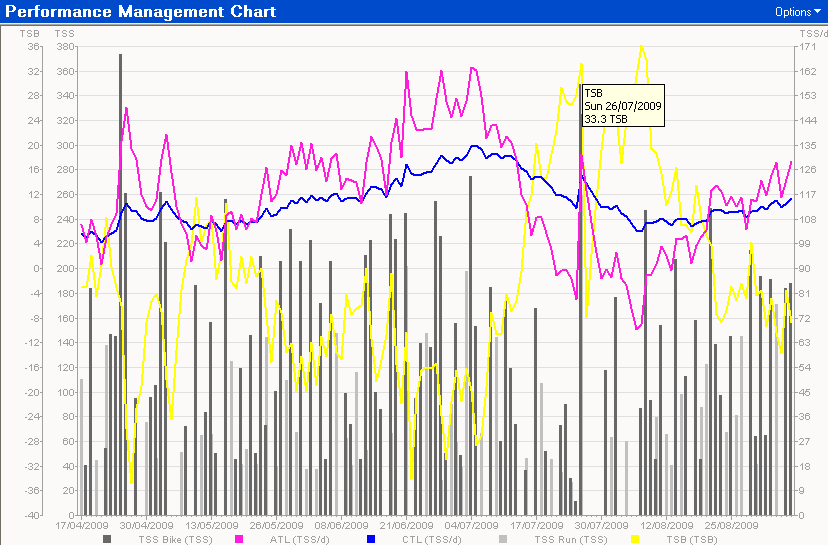
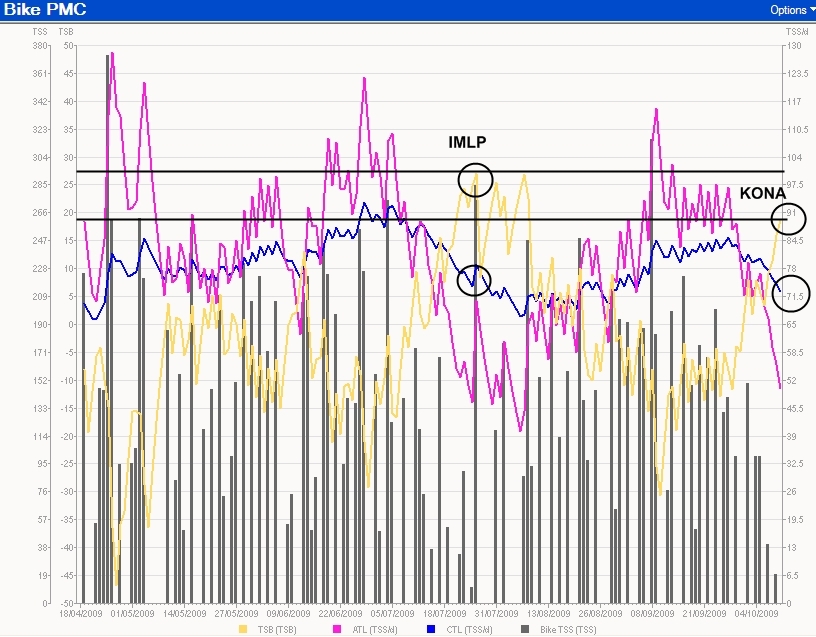
I had a look at my own Performance Management Chart from WKO+ and checked out the numbers. Sure enough, between my taper start date of July 5 and race date of July 26, my CTL (blue line) had gone from 133 to 112, a 15% drop. And my TSB (yellow line) was over 30, way too high! Ironically, being more "rested" through a lower ATL (red line, aka fatigue) and higher TSB is the very thing that helped me feel slow and tired and flat during the race.

Tapering is certainly part art, part science, and there are a lot of factors that could have affected my race day readiness in Lake Placid. But from studying my data below, I can see clearly now how my drastically reduced training load -- too much too soon -- nearly blew my race though a poorly-executed peak period and taper.

PMC
How not to peak/taper

In Part II I'll take a stab at describing what my peak period and taper for Kona should look like, and what I'll do differently to achieve it (and in doing so, hopefully achieve a better race day freshness than I did at Lake Placid).

If you're not familiar with WKO+ and all the terms I've used, here's a basic crash course.

Thursday, 6 August 2009

Ironman Lake Placid Race Report or How I won my age group and got a Kona slot

Wow, a whole month since I've posted anything. No real excuse other than that I was tapering for and travelling to Ironman Lake Placid, trying to get my head around the race and just generally taking it easy and getting rested. Note to self to get off my arse and post more often from now on! (and shorter posts too, this one is a whopper!)
DSC_0244
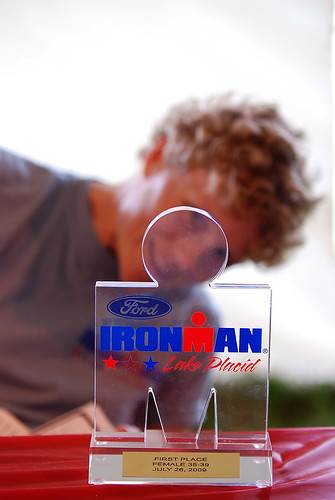
The Trophy

Anyway, the race. By now, pretty much everyone knows that I achieved what I set out to do and beyond, not only earning a Kona slot but winning my W35-39 age group. The former was never really at risk, but the latter still amazes me. How often do you really get to win something? I can count the number of races I've won since as an adult -- triathlon, running, swimming, cycling -- on one hand. What a privilege and triumph. But I'm getting ahead of myself here... of course every great race has a story, so here's mine.

Prologue


We left the UK on July 14, flew to Boston then picked up the rental car (fully loaded with a bike box (mine), bike bag (Jim's), two large backpacks and two small ones. Thank God for American cars, this would not have worked if we'd been flying and renting a car in Europe!) Drove straight to Ottawa that day, arriving after midnight. My brother and sister-in-law were generous enough to put us up for the week, which meant great food, even better company (my parents and sister came up on the weekend to visit) and lots of downtime to ride around Ottawa. In particular the Gatineau Park is a fabulous place to ride, but I'll save that for another post.

A week later we drove to Lake Placid to get settled into our three-bedroom condo just on the north side of town. We'd lucked into a place with some other folks when one of their friends had been unable to do the race, thanks to a nasty car/bike accident. It turned out to be perfect for us, though, as our housemates were fantastic and a great mix of first-time IM competitors, vets, and supporters. We were close enough to walk to town but far enough to be away from the bustle of the Ironman Show, which can really wear you down if you're immersed in it 24/7.
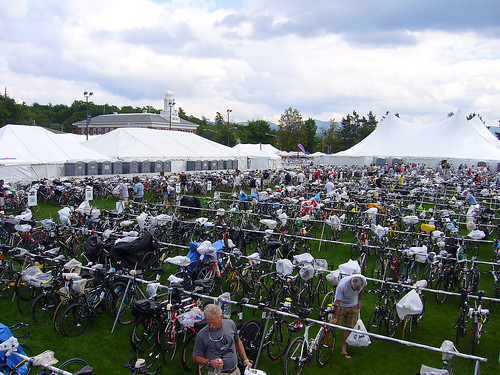
_P1020485
Transition Zone

I had been feeling a bit under the weather most of the week, just generally tired (despite sleeping quite well) and my stomach was a bit off (though I did avoid eating a lot of junk food -- no Taco Bell the whole time I was in North America!) That was a bit worrying, but I knew I'd done the training and I was prepared. We spent the days before the race driving the bike course, riding the sections that I thought might be good to know in advance, namely the descent into Keene and the climb back into Lake Placid. I also ran the big hill on the run course into town so I knew how it would feel on rested legs (on rested legs it was tough, so on the day I knew it would be a heartbreaker!) The night before the race my stomach did not want the usual two bottles of Ensure I force down, so I went with one bottle and a bit of Sustained Energy, then went to bed and tried to get some rest.

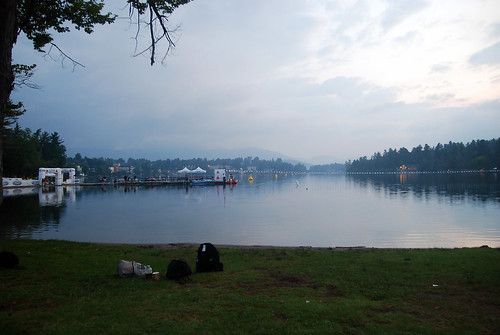
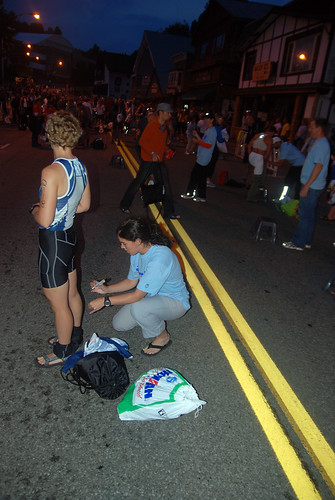
Race morning dawned, tummy still not happy but not rebelling either. Dropped bags at Special Needs, then onto the body marking station. It was 5am, still dark but the place was completely alive. Lake Placid certainly gets behind its Ironman! Half the town must have been out there already. The weather was fine so far, muggy and cloudy, but calm and warm with a threat of rain but otherwise predicted to be a good day. Mirror Lake epitomised its name, for a short while anyway til 2250 athletes and thousands more spectators invaded its waters and banks.
DSC_0005
Body Marking

DSC_0012
Mirror Lake at 5am

The Swim

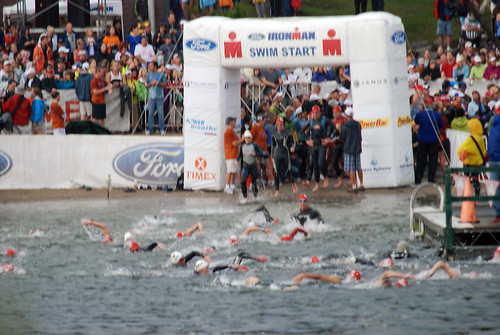
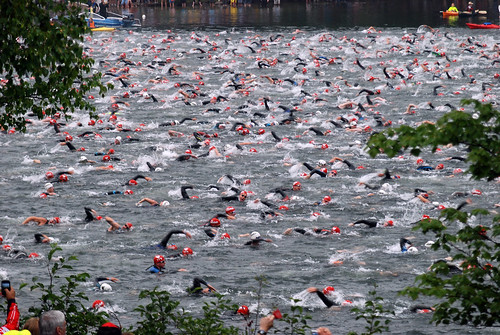
It had started to rain quite hard just before the swim started, though those of us in wetsuits didn't mind of course. The pros set off at 6:50am and ten minutes later the American anthem had been sung and the gun went for us. I had seeded myself right near the buoy line (at Lake Placid the swim course is marked by permanent buoys connected by a yellow underwater rope, making staying on course pretty easy) and pretty close to the front. One thing I don't mind is the washing machine bump-and-grind that characterises mass swim starts; as an ex-club swimmer and lifeling ice hockey player, I generally feel both comfortable and protected in the water. All those bodies moving in the same direction mean extra free speed for me, so bring it on! As it was, I ended up getting on some good feet just inside the buoy line and only came outside of it to go around the corners.
DSC_0027
The Washing Machine

DSC_0044
Lap 1 to Lap 2

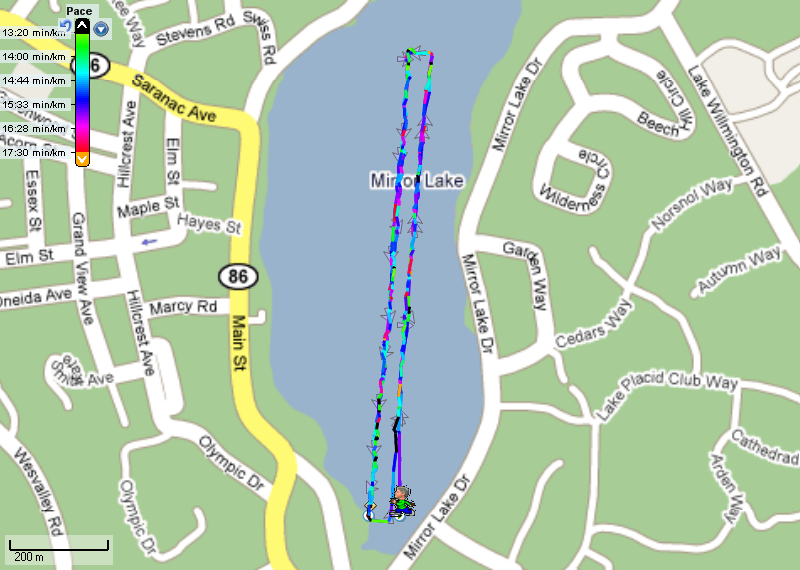
I had been swimming the course earlier in the week with Jim's Garmin 305 and thought that the course was a bit long: one lap exactly following the underwater cable was 1960m instead of the 1900m it should be for an Ironman. Not that 60m (120m for the whole course) matters to me, but at least I was prepared for when the clock said 29:28 as I came over the mat, ran across the beach and jumped back in for the second lap. The second lap is always slower just by virtue of fewer people moving in the same direction. So I knew my swim was going to be slower than IM Germany and defintely slower than the sub-60 minutes I'd hoped to go. This wasn't helped by my ridiculous re-entry into the water where I followed some guys the long way around the dock. Regardless, it was a nice swim. My only regret was taking off my swim cap as I ran along with my wetsuit under my arm towards T1. The Garmin was under there, and while I managed to juggle it, the cap, my goggles and earplugs all together, at some point I dropped the Garmin and had to double back to look for it (at a few hundred dollars, I didn't want to lose it, not to mention my data on it!) Thankfully a volunteer saw me looking, took my race number and offered to find it for me so I could carry on. I hoped for the best and made my way to T1.

Swim time: 1:01:58 as 29:28 first lap and 32:30 second lap, 6th AG and 239th overall
Ironman Lake Placid swim 26-07-2009
Swim course and speeds

DSC_0056
Chute to T1

T1 and The Bike

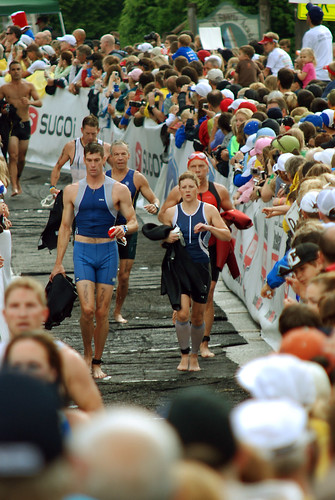
A long run up to the Olympic Oval where the bikes were racked, made amazing by the throngs of people lining the chute screaming like crazy. Transition was pretty easy, I grabbed my bag and ran into the tent, threw on my helmet, sunglasses, race belt and shoes and handed my wetsuit and gear back to a volunteer. Since I've discovered 2XU Endurance Tri shorts this year, I've been able to swim, bike and run wearing the same clothes throughout, which makes for quick transitions. My number had been called out on the megaphone but by the time I reached my rack, I was greeted by a poor confused volunteer who sort of looked at me helplessly. I was fortunate that my bike was only three spots from the end of the row, so I just waved at her and smiled and grabbed it myself. She looked relieved and I was on my way, running through the grass in my bike shoes.

T1: 5:13, 4th AG and 177th overall
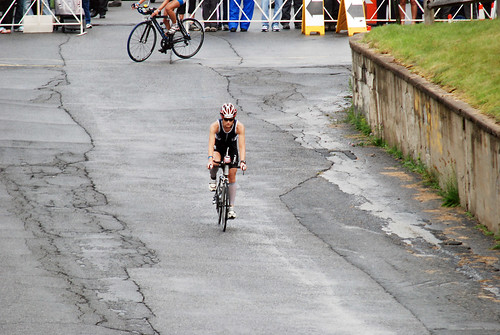
DSC_0062
Straight out of T1

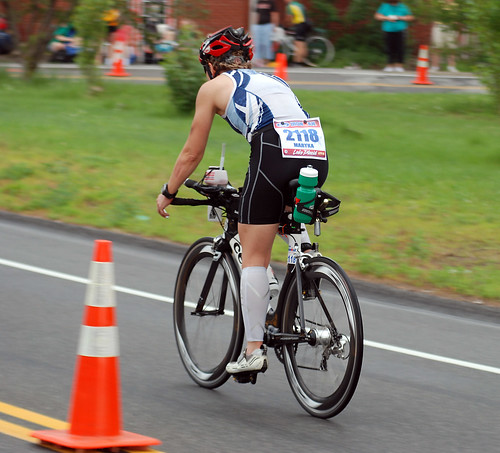
The rain had stopped but the roads were still wet, and with a crazy 180-degree turn followed by a steep downhill straight out of transition then another sharp corner and more downhill, I mounted my bike and rode the first few minutes very gingerly. Once out of town, I settled in and assessed myself. Stomach still not happy, though feeling hungry which I took to be a good sign. Legs however were unaccounted for. Still, not time to panic yet, it's only an hour into the race and I've got at least nine and a half to go! I climbed out of Lake Placid in an easy gear, then ate a bit of my Perpetuem mix before tackling the 7.5km descent into Keene (where I managed to average 54km/h on the first loop and 52km/h on the second -- max was over 70km/h which I know is not super fast, but then again I'm a bit of a lightweight!) The roads were closed to cars which made me feel better than on the day I had practised it, though the winds are tricky through there and my 60mm deep front wheel had ideas of its own about where to go. I kept repeating to myself "you are a good bike handler! this descent is easy!" the whole way down, which seemed to work as I didn't crash like a few unfortunate folks I saw along the way.
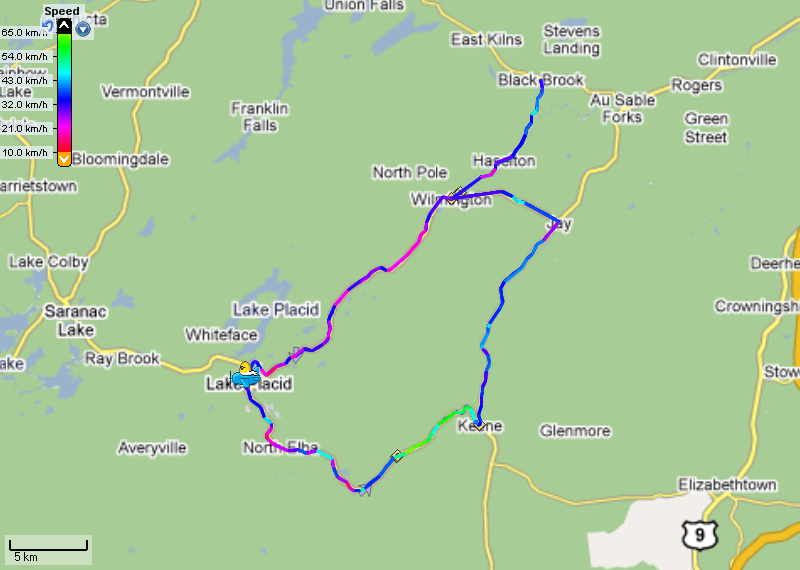
Ironman Lake Placid bike 26-07-2009
Bike Course and speeds

From Keene to Jay was a massive tailwind and given the number of fast guys on the course by then, I was towed along by the draft it seemed. It actually took some effort not to draft as there were just so many bikes along there. Overtaking one person just to hit another's draft zone was frustrating and meant I either had to continuously overtake at least three people a minute (maximum 20 seconds in each person's zone) or pick and choose who I should pass and who I should let sit legally in front of me. Once we hit the hills between Jay and Wilmington, things broke up a bit more, but even so this was a difficult course to ride 100% within the rules. Thankfully I didn't see any huge draft packs and the smaller ones I saw were breaking up regularly due to the hills and aid stations.
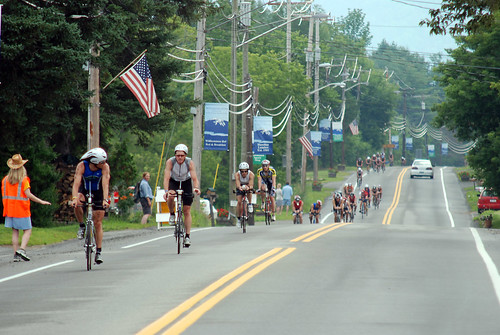
DSC_0073
Heading into Wilmington

Jim had left town right after I got through transition, and had ridden the opposite direction on the bike course so he could meet me before the out-and-back section for photos and encouragement. By then -- 45km into the bike leg -- I knew I was going to struggle with my body all day. I felt bloated, blah, head-achy and completely off my game. The average watts I'd planned to push on the bike just didn't happen without an alarming rise in heart rate, so I settled for racing on "feel" while keeping half an eye on heart rate and mostly ignoring the watts on the powertap. In some ways this worked great, as I was able to conserve a lot of energy on the tailwind and downhill sections of the course, yet still climb the hills the way I'm used to -- steady to FTP watts but nowhere near blowing up. In the end my VI was 1.11 for the whole race which I think is quite high. But given my state of disarray on the bike course, going on feel meant surviving on what felt right to me at the time, which meant ups and downs instead of a steady watts ride. I'm still thinking this one over and the truth is that I haven't done enough "bad" long rides and IM races to know whether I did myself a good or bad turn with this strategy. Interestingly enough, my normative watts over the whole course were only about 5-10 watts off from what I'd wanted my average watts to be! All I can say is I hope to ride more steady at Kona.
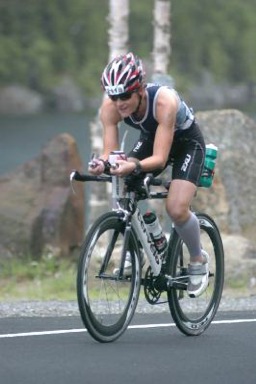
45834-781-007f
A happy moment

DSC_0078_c
The wheels are in sync even if I'm not

So, plan B then: after burping up my Perp mix a few times, I decided to back off and go with plain water for a while. I knew I had to keep up with my scheduled Endurolytes and Anti-Fatigue caps, but even those were hard to get down. In retrospect, I think I should have had more water early in the bike leg as I probably took in too many calories without enough water to process them. Given that it wasn't really warm on the bike until nearly an hour into it, and that the swim had been in cool water, I thought I didn't need as much water -- and mindful of the multiple times I had to pee during the Stein race, not to mention that I'd already peed twice during the swim -- didn't want to start drinking too much. As it was, I didn't start to need to pee until the second lap (over 3 hours into the bike leg) and didn't stop til nearly 5 hours had gone by. If that wasn't the biggest clue that I was underhydrating.... hard to believe now that I could have been so dumb! It wasn't for lack of aid stations either, it was just me being a newbie. Speaking of aid stations, at the out-and-back I tried to grab a fresh water bottle, but between the right-hand hand-off (I'm left-handed), the size of the bottle and the fact that it was cold and dripping, I managed to drop it not once but twice! Finally the third hand-off worked, but to all the folks riding anywhere near me at that moment, I sincerely apologise for making your day needlessly stressful by having to steer around my dropped bottles. Mea culpa.

DSC_0087
Crowds at the aid station

All along I'd been taking split times on the bike and I knew after the end of the out-and-back that I was in pretty good shape timewise for someone who was riding too easy and not having a great day. When I hit Wilmington just after 2 hours on the bike and started the last ~20km back into town to complete the first lap, I knew I was still in the money. Climbing past Whiteface Mountain my legs finally put in their first appearance of the day and I started to feel better all around. The Papa Bear climb was packed with cheering fans, and I got a real call-out for my in-the-aero-bars climbing technique, especially as I passed a dozen guys out of the saddle and grinding their way up the hill.

Into town and passing the crowds, I blew right by Special Needs (the flat tire monsters had thankfully stayed away this year, so there was nothing I needed anyway) and started the second lap. Pretty much the same as the first, though now the course was quite a bit more deserted, the wind had kicked up, the sun was hotter, and the people I did see were looking considerably rougher around the edges. I continued to feel a bit better, tested the waters with some more Perp, then switched to Hammer Gel instead. I attempted to pee on the bike several times between Keene and Wilmington, but as the day was sunny and bone-dry, I just couldn't bring myself to do it. Frustrated by the lost seconds spent coasting and trying to go, I finally gave up and stopped for a minute at the portapotty on the out-and-back.

DSC_0090_c
Still aero

My stomach and I had seemed to come to a truce: I wouldn't keep trying to overfeed it, and it wouldn't get worse on me (though never truly came around and felt great either). But apparently I'd forgotten to negotiate a deal with my legs because a few kms after leaving Wilmington for the final painful jaunt back into Lake Placid, I got a wicked cramp in my left quad on the inside. Tried to stretch it out and massage it on the bike, but every time I put any power into my pedal stroke it would seize up again, so I finally had to stop by the side of the road and try to fix it. This was particularly frustrating as I had been overtaking lots of people at this point (minus the stops, my split times between first and second lap were pretty good). A guy with a maddeningly squeaky disk wheel and I were trading places on the climbs and descents, and I wanted to cry when I was off my bike stretching and saw -- heard -- him go by.

The muscle cramps got me twice more on the road back to transition, the left leg again and then the right. The final time was just before the last five rollers into town, the Cherries and Bears. I pulled over to the side, right leg unclipped and in agony, thinking "the shoulder's not that wide here, better pull off into the rough so people can get by me" and promptly hit the sand and crashed on my left side, still clipped in, expletives leaving my mouth rather loudly. Some guy rode by and asked if I was all right in that sort of "I'll stop if I have to help you but I really hope you say you're fine" way -- and given the number of ambulances we'd all seen on the course, I can't blame him -- but I waved him on. Took stock of the damage, a scraped knee and big bruise on my thigh where it hit the top tube and felt pretty mad at myself. Which then sort of woke me up and got me going again, I jumped back on my bike and rode the rest of the way into town cramp-free and with fresh resolve to get the suffering over with and start the run. By the time I got through transition, I was in 3rd place in my age group and 263rd overall in the race, 114.4 miles down and only 26.2 more to go.

Bike time: 5:49:49 as 2:50:19 first lap and 2:59:29 second lap, 3rd AG and 333rd overall
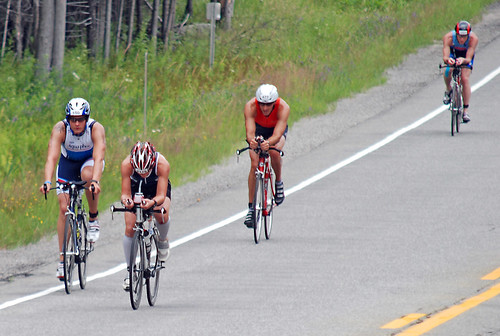
DSC_0105
Head down to climb the last hill

T2 and The Run

The second transition was quick and painless, with the only interesting moment happening when I dismounted my bike, leaving the shoes on the pedals, and ran -- rather hobbled -- barefoot towards the bag racks wondering how I was going to run a whole marathon when I could barely make it through transition? Socks and shoes on, decided to start with a visor and see how it went (lately I've been finding it cooler to run without any hat), grabbed my packet full of goodies while a volunteer slapped some sunscreen on my shoulders, and then I ran out. The packet contained all the individual Hammer gels I'd prepacked for the run, plus two Hammer coin purse thingies, one for Endurolytes and one for Anti-Fatigue caps, all in a Ziploc bag. I started loading my pockets as I ran out onto the course to save time, then tossed the baggie at the first aid station. Jim had seen me coming in from the bike course and shouted that I was in third place in my age group by only about five minutes or so. Good to know, but at this point I had to focus on running well and pacing carefully or all that holding back on the bike would be for nothing.

T2: 2:22, 2nd AG and 121st overall
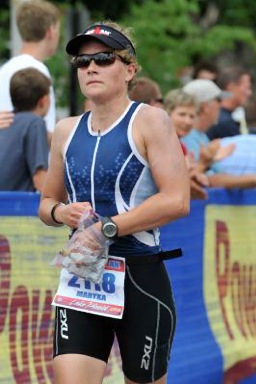
45834-149-026f
Sorting through the packet

My legs loosened up right away, and I ran the first half mile (albeit all downhill) in only four minutes, which was a bit quick for my plan. I figured I might as well take my first bathroom break to help slow me down a bit. My goal was to run about 5:10/km for the first ten kms -- those splits including all walk breaks at the aid stations -- then try to pick it up a bit or hold steady, depending how I was feeling and knowing that the last six or seven kms of the course with their tough uphills would be the hardest and slowest. I had the Garmin 405 on my wrist so I could keep track of how hard I was going, and it proved to be a great time-manager (and later a whip-cracker) for my pace. I was feeling more or less like my old self again, choking back gels as I needed to and getting my aid station ritual down: dump the old sponges at the start, grab two cups of water (one for my mouth, one over my head), a crushed fresh cup of ice to sit in my trishirt behind my neck, then fresh cold sponges across my chest. Walk just enough to make this all happen, then start running again. I was passing tons of people even in the first lap, as predictably many guys had overcooked the bike leg and were looking at a long day's suffering on the run. Just before I reached the turnaround at 9km, I saw the two women ahead of me in my age group running towards me. I estimated that only about half a mile separated us which put an age group win in reach for me, unless one of them turned out to be a great runner. But as I ran back I spotted the fourth place girl about the same distance behind me. Nothing I could do about it, just had to keep going.
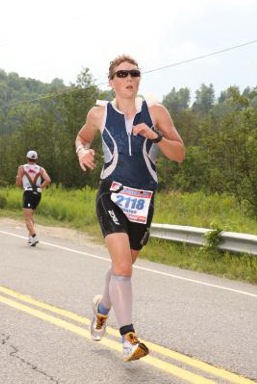
45834-488-034f
Running the tangents

Up the hill to town and man did that hurt. People were already walking. At least I knew how long it was and that it flattened out after the corner, so I dug a little and kept running. Through town and onto Mirror Lake drive to complete that cruel race director's joke called the second out-and-back. On the first lap, at least the Special Needs bags are there providing some distraction from the fact that you need to run nearly a mile past the finish line entry point then back again before you can head out of town for the second loop. At the end of the race it's nearly unbearable to have to run past the finish chute again before you can enter it! Special Needs had only one thing I wanted: a (no longer) frozen bottle of Heed that I'd made up the night before. The sun had come out again and it was getting hot, so I also dumped my visor in the bag. That bottle of Heed tasted like nothing ever has or ever will again -- I grabbed a cup of ice and poured the Heed over top and drank like it was the last drink of my life. Awesome! It lasted until I made the turnaround and ran past the aid station again, where I chucked the empty bottle and ran past the cheering crowds feeling like a million bucks to start the second half of the marathon. Kms 20 and 21, the ones after Special Needs, rang in at 5:00 and 5:05 respectively, keeping my overall pace to that point at 5:15/km. I did feel bad, however, to see the folks still riding in after their second bike lap and who hadn't even started the run!
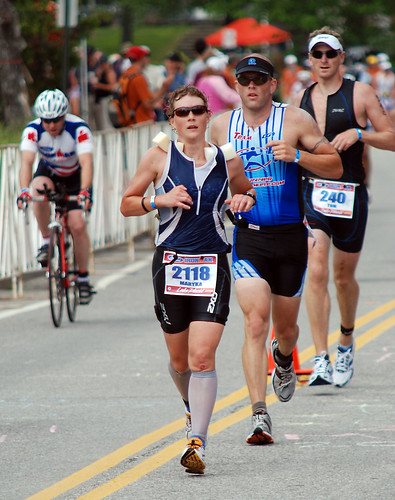
DSC_0126
Fleetfooted after Special Needs

Running downhill out of town again, I finally saw the end of of a long day slowly coming into sight. Just had to keep up the relentless forward movement, counting down the miles -- now fewer to go than I had done -- and I would be done with Ironman Lake Placid. The run course was really crowded now as most people had started the marathon, and it was hard to tell who was on the first lap and who was on the second (note to IMLP organisers: little bracelets to hand off after the first lap would help competitors keep track of each other!) The run out River Road to the turnaround was again pretty quiet, though the cramps that had taken me down on the bike were threatening to return again on the run, this time in my calves. My aid stations walks were becoming longer and I had to stop several times to stretch out my calves. I had been running the tangents, saving myself as much distance as possible, but now I wondered if it was better to run slightly longer but in the shade. Midway to the turnaround I saw two women in my age group coming at me and looking quite strong, and in my mentally exhausted state couldn't remember if they were the same women who had been ahead of me all along. If they were, then they had me beat by a fair bit. If not, then where were the women ahead of me? At that point I realised that it was out of my hands either way. I couldn't run any faster without risk of cramping up, and as long as I didn't slow down, I wouldn't lose any places (the 4th place girl who I did recognise in her Endurance Nation kit was falling behind steadily). So to my great relief, I just gave up caring where anyone else in my age group was and ran on as best I could.
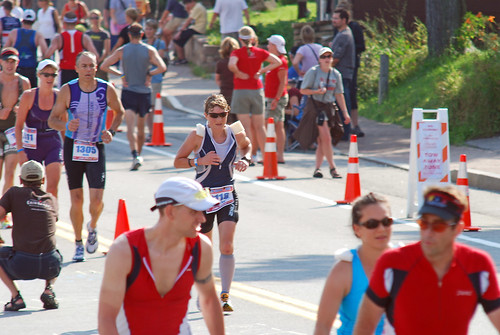
DSC_0140
Trying to run, not walk

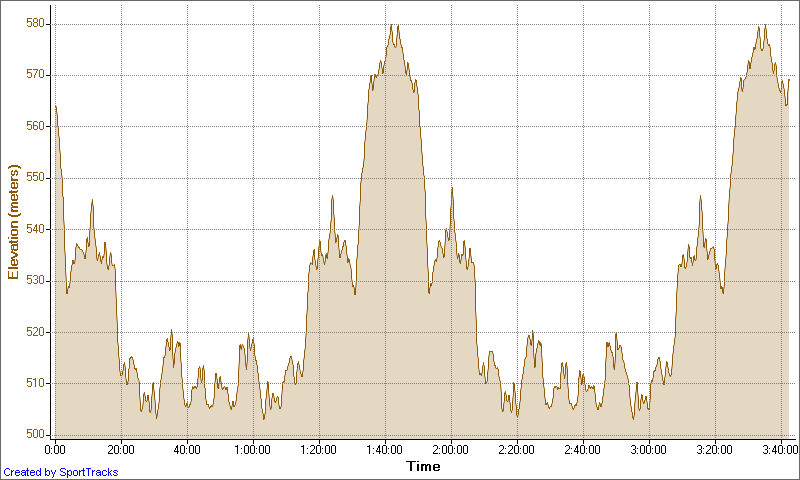
Ironman Lake Placid run 26-07-2009, Elevation - Time
Run Elevation and Gradient

Turned out that the two women in front of me were fading fast while I was still running 5:17-5:18/km, but I didn't manage to catch them until the final half hour of the race. I barely noticed overtaking them as I was going by tons of people by then, particularly on the hills where many were walking, and the body marking had worn off hours ago. Later, the third place girl would tell me she saw me go by but just couldn't hold my pace. I saw Jim at the top of the hill with less than two miles to go and suddenly had a moment of panic: what if there was some hotshot marathoner who'd been creeping up on me all this time the way I'd crept up on the others? I shouted to Jim "who's behind me?" and he gave me a confused look. "Everyone is! You're in first place!" I shook my head thinking it couldn't be possible, what about those speedy ladies I'd seen before? But no time to argue, I had to keep going but for the first time I allowed myself to think that I might actually win my age group.

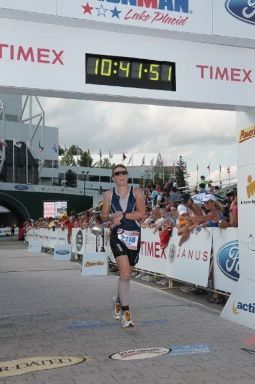
Just that awful last out-and-back to do along Mirror Lake, helped immensely by the thronging masses cheering me along for actually still running at a reasonable pace, then I was done. I made sure to toss my sponges and ice at the aid station to make myself presentable for the finisher's photos, and Jim (where did he come from? must have hoofed it up that hill double time!) shouted to smile when I crossed the line. Then into the Olympic Oval and half a lap around before running under that magical Ironman banner. I reminded myself that this could be the last race I ever do -- after all, you never know what could happen in the future -- which did indeed bring a grin to my face, and with a sort of gay fist pump I ran across the line. In the end I ran the fastest marathon in my age group.

Run time: 3:42:31 as 1:49:16 first lap and 1:53:15 second lap, 1st AG and 131st overall

45834-579-002f
Fist Pump!

45834-415-005f
Across the finish line

The Aftermath

Despite aching legs, I actually felt pretty good when the race was over. Mike Reilly had called out my name when I finished, but no mention was made of what place I was in my age group so I still wasn't quite sure I had won. I grabbed some food then got my dry clothes bag and took off my wet shoes, socks and calf guards. Found Jim and chatted briefly, then went to get my scraped knee bandaged and a massage before my muscles completely seized up on me. The medical tent was full of rough-looking folks --only 152 people out of 2250 had finished in front of me and half of them were in that tent! But given the number of ambulances carting people from the run course I wasn't really surprised. As much as I wondered how good it would be to get an IV, I knew I didn't need it, so I got changed into my compression tights and went out to take care of some lingering business: checking out the results and tracking down the lost Garmin!
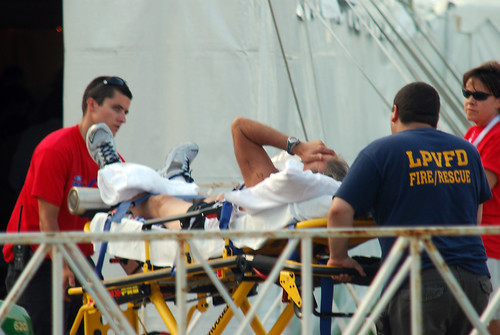
DSC_0153
Thankfully I didn't need one of these!

Seeing my name listed as first in my age group, it finally sunk it that I had won! I immediately felt a sense of guilt, as I had had such a bad day that I almost didn't believe I deserved it. Still, upon checking out the bike and run times, I realised it was my months of training and my race execution on the day that got me through it, and not how good or bad I felt during the race. Staying cool-headed and trusting myself rather than panicking or giving up was the key to getting through the tough moments. So in that sense, it was one of the most deserved victories I've ever had. And ultimately, if I had to choose between an awesome day with a lesser result, and a tough day with a great result, I'd pick the latter every time. :)

Total race: 10:41:52 as 1:01:58 swim, 5:49:49 bike and 3:42:31 run, for 1st AG, 16th woman and 153rd overall
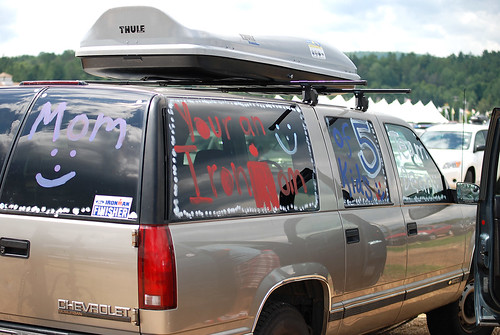
DSC_0157
Ironman Mom

The Kona rolldown was at 9am sharp the following day (we were nearly first in line) and then it was the awards banquet. Mike Reilly gave an update on the last finishers of the night and played the poignant pros, volunteers and finishers videos. Then we were presented with our trophies (little M-Dot plaques in graduating sizes) and called up by age group to the stage for photos and applause. Though it looks like we were standing in order of height, that's actually the order than we finished!
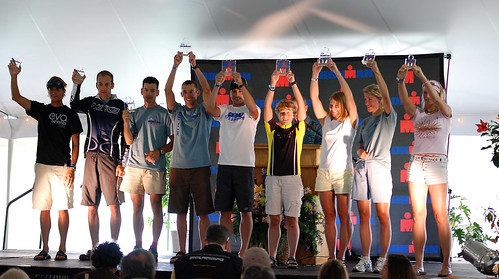
DSC_0229
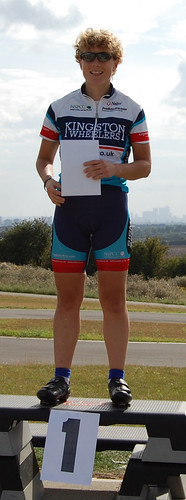
Male and Female 35-39 Podium

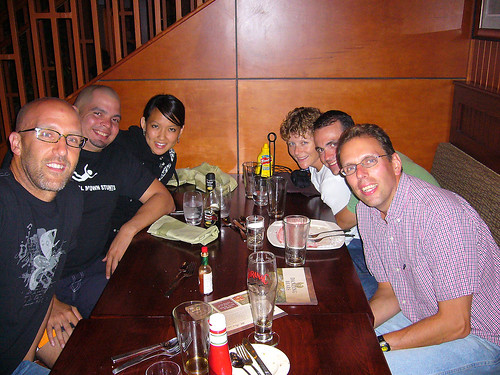
Later that evening my five housemates and I went out for a group celebration dinner, with plenty to celebrate as both Jeremiah and Esther had completed their first Ironmans with excellent results. Bob had enjoyed his time volunteering (and drinking beer for a change while in Lake Placid for race week, as he'd previously done the race several times himself as a competitor). Our loyal supporters Jim and Armando stuck it out the whole day despite the rain, the sun, the crowds and the long hours standing around wondering where we were. So a success all around and a great time had in Lake Placid.
P1020493
The gang from 4 Cherokee Trail

All pics by Jim except for a few from the official race photo guys which I'm planning to purchase shortly.

Epilogue

Some bike power data for those who like that kind of stuff:

Lap 1:
Duration: 2:50:19 (2:50:21)
Work: 1515 kJ
TSS: 137.5 (intensity factor 0.696)
Norm Power: 164
VI: 1.1
Pw:HR: -11.49%
Pa:HR: 12.33%
Distance: 89.771 km
Elevation Gain: 2598 m
Elevation Loss: 2591 m
Grade: 0.0 % (6 m)
Min Max Avg
Power: 0 344 148 watts
Heart Rate: 102 169 150 bpm
Cadence: 47 166 91 rpm
Speed: 0 75.8 31.6 kph
Pace 0:47 0:00 1:54 min/km
Altitude: 195 672 395 m
Crank Torque: 0 57.6 15.6 N-m

Lap 2:
Duration: 2:59:29 (2:59:30)
Work: 1587 kJ
TSS: 147 (intensity factor 0.701)
Norm Power: 165
VI: 1.12
Pw:HR: -2.99%
Pa:HR: 23.89%
Distance: 90.3 km
Elevation Gain: 2597 m
Elevation Loss: 2606 m
Grade: -0.0 % (-10 m)
Min Max Avg
Power: 0 394 147 watts
Heart Rate: 104 170 154 bpm
Cadence: 30 166 90 rpm
Speed: 0 93.5 30.2 kph
Pace 0:39 0:00 1:59 min/km
Altitude: 195 672 396 m
Crank Torque: 0 66.8 15.8 N-m

Entire workout (30.9 kph):
Duration: 5:49:49 (5:49:52)
Work: 3102 kJ
TSS: 284.4 (intensity factor 0.698)
Norm Power: 164
VI: 1.11
Pw:HR: 2.62%
Pa:HR: 7.25%
Distance: 180.083 km
Elevation Gain: 5194 m
Elevation Loss: 5198 m
Grade: -0.0 % (-4 m)
Min Max Avg
Power: 0 394 148 watts
Heart Rate: 102 170 152 bpm
Cadence: 30 166 91 rpm
Speed: 0 93.5 30.9 kph
Pace 0:39 0:00 1:57 min/km
Altitude: 195 672 396 m
Crank Torque: 0 66.8 15.7 N-m

And run data too:

Lap 1:
Duration: 1:49:15
rTSS: 126.8 (0.788)
NGP: 5:05 (196.8 m/min)
Pa:HR: 7.29%
Distance: 20.719 km
Elevation Gain: 418 m
Elevation Loss: 408 m
Grade: 0.0 % (9 m)
Min Max Avg
Heart Rate: 91 162 145 bpm
Speed: 0 16.7 11.4 kph
Pace 3:36 0:00 5:17 min/km
Altitude: 504 583 530 m

Lap 2:
Duration: 1:53:25
rTSS: 128.1 (0.781)
NGP: 5:09 (194.0 m/min)
Pa:HR: 2.5%
Distance: 21.354 km
Elevation Gain: 442 m
Elevation Loss: 451 m
Grade: -0.0 % (-9 m)
Min Max Avg
Heart Rate: 104 161 151 bpm
Speed: 0 22.5 11.2 kph
Pace 2:40 0:00 5:22 min/km
Altitude: 504 583 531 m

Entire workout (149 bpm):
Duration: 3:42:40
rTSS: 259.5 (0.785)
NGP: 5:07 (195.5 m/min)
Pa:HR: 4.98%
Distance: 42.073 km
Elevation Gain: 860 m
Elevation Loss: 860 m
Grade: 0.0 % (1 m)
Min Max Avg
Heart Rate: 91 162 148 bpm
Speed: 0 22.5 11.3 kph
Pace 2:40 0:00 5:19 min/km
Altitude: 504 583 531 m

Tuesday, 7 July 2009

The speedy P3C and the Hed wheels that were worth the wait

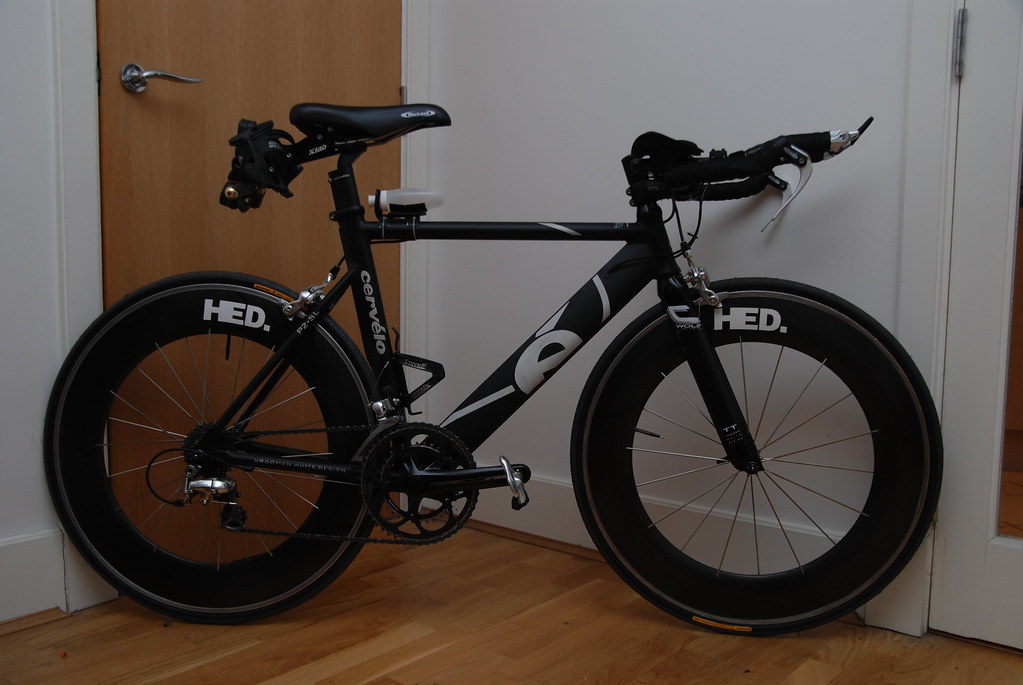
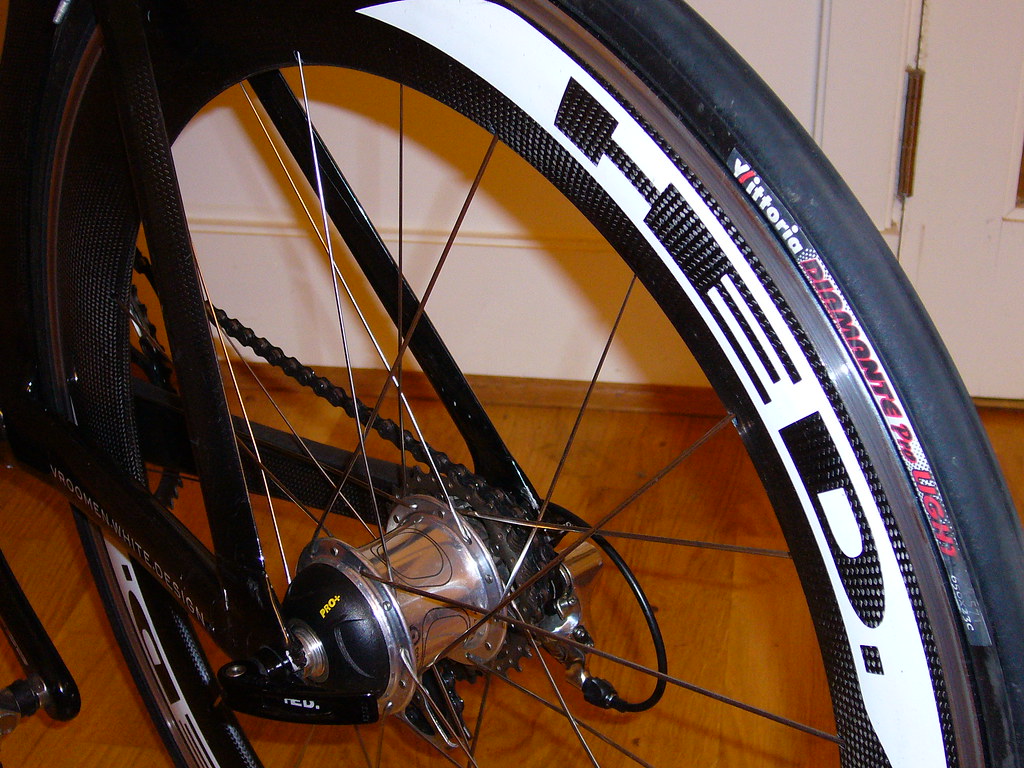
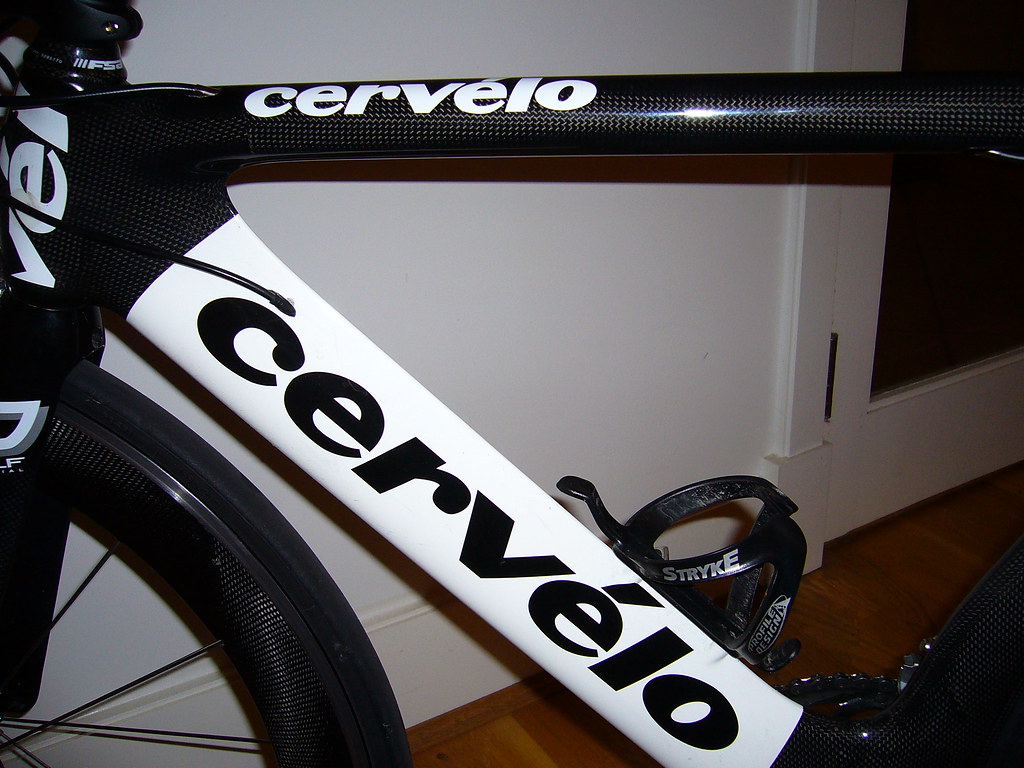
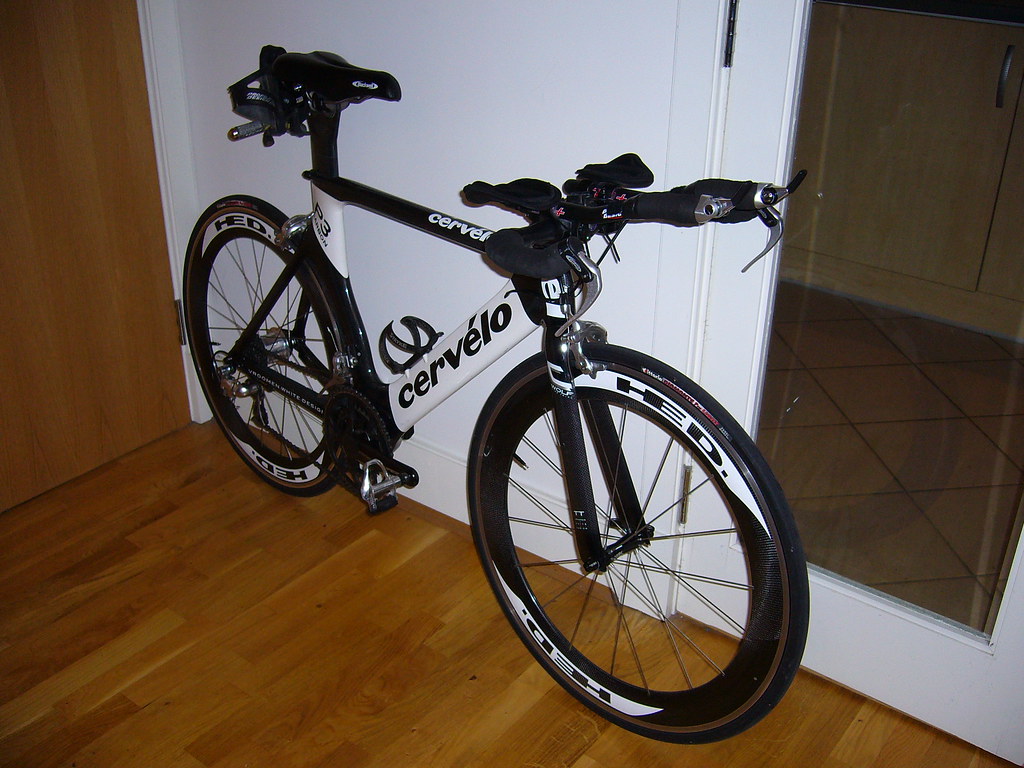
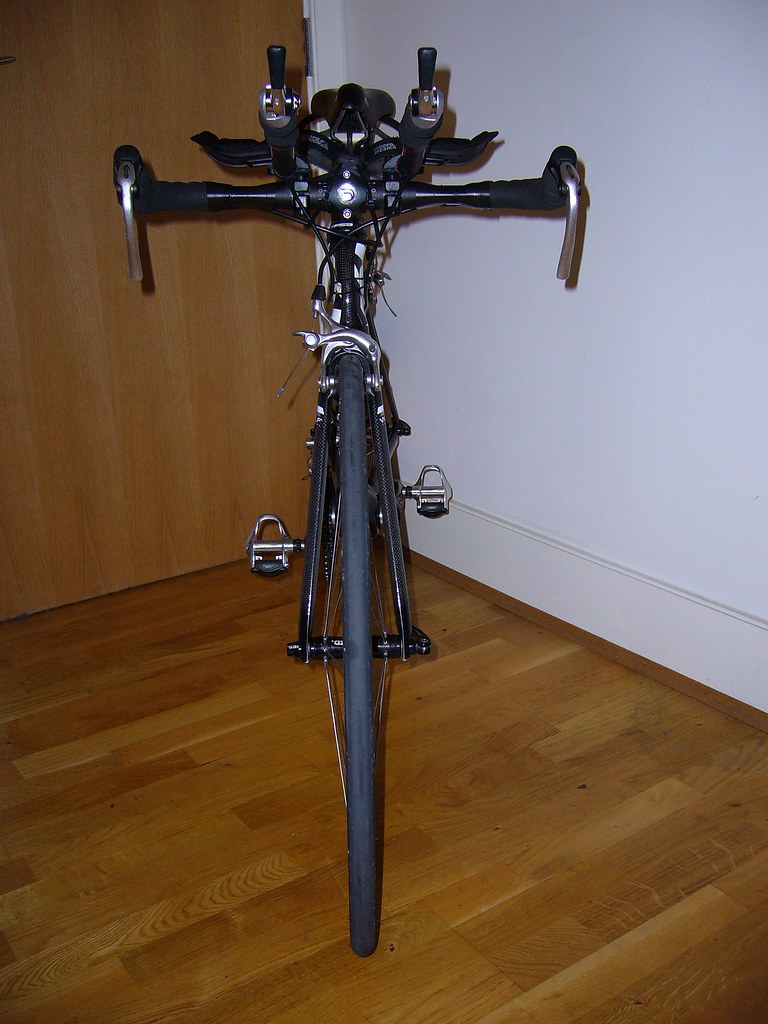
The weather's gone from beautiful and sunny and almost but not quite too hot the past couple of weeks to cool and rainy today, more typical English summer weather I suppose? Given a hard couple of training weeks including a 165km ride on Saturday, I've felt a bit blah the past couple of days. So I figured I'd blog about my new (used) TT bike to help pick up my spirits. It's a 2006 Cervélo P3C with a Powertap Pro+ in Hed Jet C2 60mm rims. In short, more carbon fibre than I've ever seen in my life, and easily the most bling bike I've ever owned.

It's funny to reflect on how my bikes have evolved since I did my first Try-a-Tri on my old mountain bike back on Labour Day weekend, 2003. After that race, I was well and truly bitten by the tri bug, so I set about finding a "real" road bike and ended up with a circa 1988 12-speed Italian roadbike knock-off that I picked up for $100 at a secondhand sports store. I replaced the drops with tribars and managed to rig up the downtube shifters to the aerobars, though I couldn't get up any hill over 5% without standing due to its 53/39 Biopace rings and 11-24 cogset. Still, it did the trick for the next two summers and even saw me through my first half-Ironman. Alas, it's been sitting in my parents' shed ever since I left Canada and though I've been resisting for a while, I've finally given in to their wishes to just get rid of it. My sister will probably sell it at a garage sale for $50...

The trusty old 1980s "Finelli"


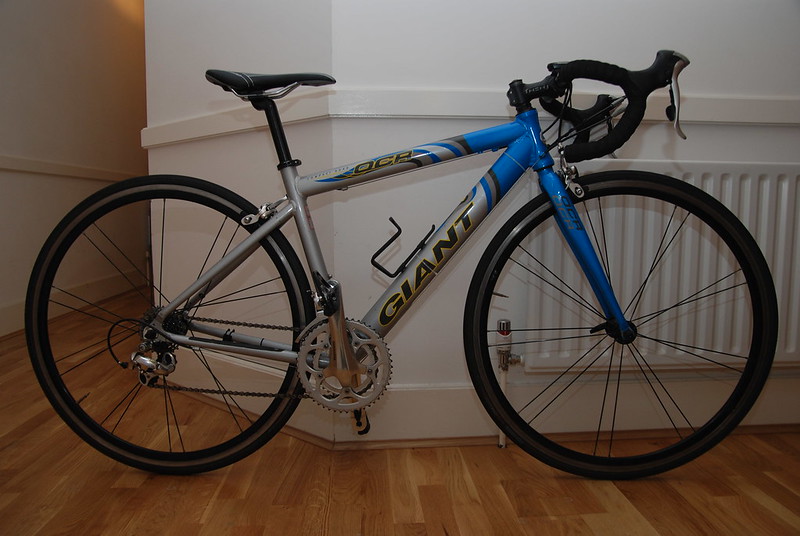
When I moved to Holland in 2005, I bought another old steel roadbike, this time a Batavus, as my daily getabout, stuck some flat bars on it and used that for the first few months of bike training until I found a secondhand 2002 Giant OCR for €400. With clip-on aerobars and a nice female-friendly saddle, I rode that Giant into the ground for the next 10,000+km, including a trip to Lanzarote where it got lost on the way for three days, all kinds of races from sprints to 3/4-Ironmans, and even a city criterium on the cobbled streets of Utrecht. It was finally replaced by my Cervélo Soloist Team a year ago, and after riding that for a few months I realised that the OCR is actually just a bit on the big side for me. So with the addition of the Fuji track bike cum fixie last Christmas into the overcrowded bike room, I knew it was time for the OCR to go. With sadness I sold it for £180, trashed Rolf wheels and all, where it was parted out by an enthusiastic Bike Radar bike flipper -- hopefully the frame has gone to a good home!
DSC_0003
2002 Giant OCR


Once I knew I'd want to tackle an Ironman -- and coincidentally decided that I was finally a "good enough" cyclist to get a nice new bike -- I figured I'd better get a proper TT bike. The mid-priced and solidly engineered Cervélo P2SL fit me like a glove, so I picked up a new old stock in beautiful anodised black when home on vacation in the late summer of 2007. The difference in speed was immediately noticeable, as it had 650c wheels which allowed me to get quite a bit lower and more aerodynamic. It got me through a number of races including Ironman Germany and with some secondhand Hed Deep wheels it was going to be my IM Lake Placid bike this year.

2006 Cervélo P2SL with Hed Deep wheels


Which brings us to the P3C. Jim found the right-sized frame for a great price on ebay, and once we won the auction and picked up the bike, I set about transferring over all my bits from the P2SL. After that, it was just a matter of waiting for my Hed wheels to be built with the Powertap Pro+ for the bike to be race ready. And frustrating as that wait was, it was well worth it as this is by far the fastest bike I've ever ridden! After three weeks of tweaking the bars and stem and saddle, all the while hoping my legs would remember what it was like to ride in that low TT position enough to regain their power, last weekend it all finally came together.

2006 Cervélo P3C


Hed Jet C2 60 rim with Powertap Pro+ hub

With a 30km run in my legs from the day before, I set off on what I thought would be a ~150km/5-hour ride on a more or less flat course, the goal being to cycle at Ironman watts with a few harder intervals thrown in. The wind was pretty strong but to my surprise it never felt like a headwind unless I was literally riding straight into it; at every other angle, I felt like the wheels were being pushed along like a sail. I kept looking down and seeing speeds between 34-38km/h while barely hitting 150 watts, something that would be unheard of on my regular road bike. When I caned it along at 200 watts for 30 minutes into that direct headwind, I managed to hold 36km/h! Later with the tailwind it was an effortless 45km/h as I overtook cars in the towns I passed through. Finally home 5 hours and 23 minutes later, to my amazement I had ridden 165km in 5 hours flat of riding time.


All that shiny gridded carbon

No doubt that Ironman Lake Placid is hilly but that one long ride has done more to boost my confidence for the race than any ride has in months. I've started to taper this week, easing back on the high volume though keeping up the intensity, and my last big race rehearsal ride this weekend on reasonably fresh legs should yield similar if not better results. I've got half a mind to find a last minute 100 mile time trial if only they'd let me have a late entry...


A few more shots of the P3C and my setup:


Profile Design bars, nearly infinitely adjustable


Nice narrow profile for the wind

Monday, 22 June 2009

Stein Long Distance Triathlon Race Report

We just got back from our whirlwind Benelux trip, which started with a ferry over to France then a drive to Luxembourg where we stayed three nights at a great little holiday apartment just outside Vianden. On Saturday we headed north to south Limburg in the Netherlands for my long distance triathlon race in Stein on Sunday. Despite weather that always seemed to be threatening rain, we had two 100km cycling days in Luxembourg: home of colourful and immaculate little houses and farms, great climbs and descents, and quiet well-paved roads. The weekend included an obligatory trip to Albert Heijn, and we got to see some of my Hellas Triathlon friends who were racing in Stein as well. The only downside was the 22-hour day we had getting back to the UK yesterday after the race was over, though it was much worse for Jim (who did all the driving) than for me (who raced, then got to sleep on the ferry).


colourful houses in Bettel, Luxembourg


Hills and valleys of lush farmland as far as the eye can see


The Stein long distance race is billed as being in the "Dutch Mountains" which is kind of cute -- it'd be like saying a race in the North Downs is in the Surrey Mountains! With a cheap entry fee of €85 and huge prize money open to everyone (not just pros), it's surprising that this race isn't more popular especially amongst British women who I think would be very competitive here. I've done it three times now (twice as a solo racer, once in a relay) and would recommend it to anyone who wants a low-key, well-organised and spectator-friendly race not too far from home in a very hospitable part of the Netherlands (Stein is just north of Maastricht right in the middle of Amstel Gold country). The race weekend also has a bunch of kids' races on Friday evening and both a sprint and a draft-legal Olympic distance Saturday afternoon. The long distance race is all day Sunday.


Waiting for the swim start


Running out of the water to my bike

The swim is 3km in the port of Stein (water was 20 degrees and calm, though a bit "industrial"), two loops with a quick exit/entry between. The day was unusually cold and rainy early on, making it a bit hard on the spectators, though Jim toughed it out despite having no rainjacket or umbrella handy. I got out of the water in 48 minutes, knocking a couple of minutes off my previous best time for that course. I can probably chalk it up to being very comfortable in the water and getting on some good feet, I think. Transition was slow as I pulled on a bike jersey over my trisuit for extra warmth.


Absolutely pouring rain!


Nonetheless, I was pretty happy with my new P3C

The bike is four laps of a twisty 27km mostly flat course with the three Surrey-like hills, one made of big cobblestones. The northern Dutchies with their 11-23 cassettes were weaving all over the road trying to get up the 14%er by the last lap, which made for an interesting sight. It took me about a lap and a half to get comfortable on the bike, as my legs were feeling the kms we'd ridden in Luxembourg. My plan was to ride at Ironman pace anyway so that I could put in a strong run and treat the whole race as a training ride, so I was okay with that. The rain started to pelt down hard by the second lap and I saw more than a few folks by the side of the road struggling with flat tires. Two of the female pros dropped out due to the cold and two guys managed to crash their bikes on the tricky descents leading to the climbs. I was able to pick up the pace in the third and fourth laps as the sun finally came out and I warmed up a bit. With a time of 3:35 I came in to T2 about 100th place of 200 competitors but with lots of energy in reserve.


By the time the run started, the roads had dried up and the sun was coming out


Very light-footed on the run, which was a nice feeling

The run is also four laps with two steepish hills winding through the town of Stein, each 7.5km lap finishing in front of the grandstand in the middle of town with the announcer calling out names. The entire town gets into the race, what with people sitting in their front garden cheering everyone on, and little kids collecting and distributing sponges and water. My target for the whole race was sub-7-hours (having done 7:30 in 2007) but my running was even better than expected, and with a 2:19 for 30km I ended up with a 6:46:47 final time. Good enough for 7th place woman and 48th place overall, overtaking many guys who had blown by me on the bike then blown up on the run, as usual. Three of my Hellas buddies put in a solid performance to take first prize in the mixed relay race, with another three Hellassers forming a second team who just beat me by 17 seconds. Three other teammates who were racing solo finished strong as well.


I had hoped to go sub-7 hours so this was a great time

The prizes (€2700 for the winner down to €550 for 5th place in the women's race and €200 for 7th place in the men's, plus €100 for each age group winner) attracted quite a few pros this year. The men's winner was Fraser Cartmell of Scotland, the women's was Natallia Barkun of Belarus who also picked up another €500 for breaking the course record. I was disappointed to see my time 11 minutes out of the money, considering the same time woud have earned me 3rd place two years ago, but happy with my performance seeing as I didn't taper for it and used it as a race rehearsal of sorts for IMLP. There's talk of Stein trying to get a 70.3 franchise which in some respects would be great but in other ways would ruin this quaint small-town race, not least by tripling the entry fee I'm sure.

I've now got five weeks til IMLP and it's a great relief to know that my swimming and running are where they need to be. The P3C performed really well too, though I'd still like to get a bit lower in front (adjustable stem maybe?) and tweak my position to get more comfortable in the neck and shoulders. And I can clearly see my goal for these last few weeks of hard training: to squeeze every last watt out of my FTP so I can push that tiny bit harder on the bike and still put in a solid run. Tomorrow I finally get to pick up my Powertap 650 wheel so with a few Club 10 TTs and some time spent riding hard laps of the park I can ride myself into good form, I'm sure (I hope!)

Monday, 25 May 2009

Wokingham Half-Marathon report


Early in the raceLate in the race


Thinking last week about running, Vdot, and training paces got me realising that I haven't done a timed running race in a while. Well, I did the Tadworth Ten back in January -- on frozen ground with insanely steep hills, the most sufferable 10 miles I've ever run -- but my time was so poor I'd like to forget that was even a race. I'm planning to run a 10k in the first week of my Ironman taper in July, but since a lot of my training until then is being done at half-marathon pace, I had a look around for something local and found the Wokingham half marathon last Sunday. It was originally scheduled to be run in February, but a freakish bout of snow forced its postponement as the roads were too icy. Since many folks had signed up for it as prep for the London Marathon -- long over now, of course -- that it wasn't hard to find a spare race number at the last minute.

My last half-marathon was run on a blustery February day in 2007, leaving me with a pretty soft PB at 1:40:10, so I knew that unless things completely went south, I'd get a new best time in Wokingham. Sub-1:35 was the goal, sub-1:33 the dream, but the recent hot and sunny weather had me reconsidering how hard I should go. I've done only a few runs in 20+ degree temps this year, and all were either slow or painful or both. Sunday morning dawned completely clear blue skies and 15 degrees already at 7am, so it was going to be a "scorcher" as far as May in northern Europe goes. (Note to my Ontario friends: yes, I can hear you all laughing now from your air-conditioned comfort that 20 degrees is hot, but let me tell you: when you're not acclimatised to it and suddenly have to run in full sun and warm weather, it might as well be Hawaii!) So I dressed in my triathlon race kit -- singlet and trishorts, calf guards and sunglasses, foregoing the hat for a change so my hair could get some sun -- and headed to the race. Rode my fixie bike to the station, took the train 45 min to Wokingham and rode to the race start (planning to ride the 45km home as cooldown/recovery).

Only about half of the registered 2000 runners showed up, making the start pleasantly uncrowded. The course was reasonably flat with just a few hills (mostly highway overpasses). The first kilometre was downhill, meaning the last would be painfully uphill: nearly impossible to get a negative split, in other words. Since I tend not to go off like a rocket, I often seed myself a bit further back than I should, and this race with its 1:11 female course record had me a bit hesitant to move very far up the start chute. Had I been running in 2008 with the time I set this year, I would have finished merely 419th out of 2000 people overall and the 54th woman. To put that into perspective, in the flat and fast Toronto Waterfront half-marathon with over 6000 participants, that same time would have landed me 214th and 26th place respectively! England certainly has a lot of strong runners!

With a 4:30/km pace in my head, dead on to run a 1:35 half marathon, I set off, crossing the start line only 30 seconds after the horn. It was pretty hard not to go out at a crazy pace, given the downhill, the adrenalin and the hordes of people flying past me. But I reined in my self-control after a 6:53 first mile, and managed to get though the first 5km in a respectable 21:47 (4:22/km or 7:01/mile). This was a pace I thought I could probably sustain for most of the race if I could stay cool and hydrated. Funny how my body has an uncanny ability to "know" more or less how fast I can run for a given distance in a race; I'm usually pretty good at pacing myself based on perceived effort and feel (the Tadworth Ten, being poorly paced, is the exception that proves the rule). Funny how most other people, Garmin devices or not, have no idea how to pace themselves and the ones who fly by me early usually implode around halfway and plummet backwards! This was going to be one of those days, made even worse by the warm weather. People were going to be suffering later, I could tell.

The first aid station was at 3.5 miles, and I promptly grabbed two cups of water to dump over my head and another to drink. Nobody else seemed to be doing the water over the head thing, surprisingly, but I didn't hold back. Every aid station brought fresh cold water for my head, neck and back, and I gulped down as much as I could (which is never very much but always seems to be enough). By 10km (43:54) I was surprised at how easy it all still felt; in fact, I was running along feeling so good that I started wondering why I didn't race half-marathons more often. It seems like the perfect distance, really: long enough to be run at a strong but not killer pace, short enough to limit the muscle pain to only the last few miles or so. 5k races are bleary-eyed flat-out gasping for air, 10k is a battle between you and your lactate threshold, and 15k is run right on the limit of (dis)comfort. But a full marathon starts out boring and shifts to painful with only a small window of enjoyment between about 15-25km. So a half is really the perfect distance to race, and also the perfect distance to train for, requiring a good mix of volume, distance and speed work but nothing long or crazy. Why have I only discovered this now?

15km came and went at 1:06:08 -- a new PB for that distance too, I'm pleased to report -- and with it the last water station. Right around that time, the course turned back south and the sun was full-on, all the shade disappeared and the wind was now slightly behind me. And I faced the worst hills of the day, with the same 50m in climbing that I'd descended in the first 6km. None of the hills were steep, but the combination of heat and sun, along with the now-starting-to-hurt downhills made them tougher than I expected. Passing the mile 11 sign, my patience was finally up and I started to run faster, wanting to see if I could break that 1:33 that I'd been keeping in the back of my mind.

Overtaking the people who'd blown up and were walking spurred me on, but just as I hit the mile 12 marker, I was seized by a massive side stitch, like I'd been stabbed. This has happened a few times in training, always after I'd been running for an hour or more then picked it up to tempo pace for a few kms. So frustrating! And it's not a nagging side stitch that I can run through uncomfortably, but the kind that makes it impossible to breathe and so so painful. Nothing to do but stop and hope it goes away.

So I had to stop and try to fix it. I spent about 20 seconds by the side of the road stretching my right side, digging my fingers under my ribcage to try and massage whatever was pulling everything painfully tight. I managed to get running again, albeit gingerly, but by then 1:33 was gone and I was just trying to hold on to 1:35. 12 to 12.5 miles was my slowest-paced half-mile of the day at 7:50/mile (4:52/km), including the stop. But the final km turned uphill and that helped, with no downhills to jar my body and the effort forcing me to breathe deeply. From 12.5 to 13 miles, I picked it up again to 6:58/mile (4:19/km) pace, and by the final turn I was running pretty hard, watching the race clock tick over to finish at 1:34:06. Chip time: 1:33:38 for a PB of 6 minutes and 32 seconds, good for 15th woman and 184th overall out of 1062.

I'm pretty disappointed to have to stop and walk in the last mile as I did, but given the conditions and the full week of training that I'd put in, I'm pretty pleased with my result. My resulting Vdot is up to 48.7 now and that represents what I can really do in a midday summer race, which means my training should be dead on for Ironman Lake Placid. Riding the fixie home, however, was not the wisest plan, as my legs were feeling pretty rough and the rolling roads for the first 25km did not give them much respite -- either uphill or downhill!

Final numbers:

Wokingham Half Marathon
Duration 1:33:36
Work n/a
rTSS 158.4 (0.953)
NGP 4:20 (230.6 m/min)
VI n/a
Pw:HR n/a/
Pa:HR 2.46%
Distance 21.137 km
Elevation Gain 644 m
Elevation Loss 641 m
Grade 0.0 % (3 m)
MinMaxAvg
Heart Rate 119 195174 bpm
Speed 0 19.1 13.5 kph
Pace 3:08 0:00 4:26 min/km
Altitude 26 66 46 m


With my new improved Vdot, I get to run everything 5 sec/km faster in training now. :) My new training paces are the following:

Run Zones
ZoneHRPace Mile/km
Z1/EP < 155 8:40/5:23
Z2/MP 151-159 7:24/4:36
Z3/HMP 160-168 7:06/4:25
Z4/TP 175-181 6:58/4:19
Z5/IP > 182 6:32/4:03

Sunday, 17 May 2009

Milestones and Benchmarks

Yesterday was my birthday and I've now hit that (magical?) 35-year mark. Halfway to 40, a "veteran" category runner, and apparently I should be starting now if I want to have kids someday. A lot to think about! Of course I benefit from aging up to the 35-39 category for my Ironman, and I get to use the excuse that the girls who thrash me soundly in my cycle races are young enough to be my kids (not that I was much of a sprinter when I was their age regardless!) In the sense, I should be glad to be aging, as not only am I genetically more inclined to the endurance side, I've got nearly 20 years of base-building behind me to support it. Put them in a 6-hour race against me and I'll win every time, right? So why am I racing those one-hour crits again?

Otherwise I've had a reasonable training week, getting over the cold I had last week and setting some new benchmarks and best times:

Cycling
  • Tuesday: a hard clockwise lap of Richmond Park on the road bike, setting a new best time of 19:31. Had I really wanted to set a big PB, I should have ridden the other way to have the wind at my back on the long draggy climb up to Richmond Gate, but mostly I wanted to get a 20-min baseline power level.

  • Wednesday: my first ever 10-mile time trial, a low-key event put on by my club every other week. It consists of riding 5 miles as hard as possible down a divided highway, turning at the roundabout, then riding the same 5 miles back (again as hard as possible). I put down a respectable 25:33 time, not bad considering I've never ridden the course and I was on my road bike with no aero bars. I wanted to get a baseline wattage from the Powertap so I could compare and contrast with later TTs on my TT bike (alas I'm still waiting for my Powertap 650c Hed wheel to be built).

Interesting to compare the 2 sets of data (taken from WKO+). The peak 20-min power numbers were also fairly similar (250NP/240AP for Richmond Park and 247NP/242AP for the time trial), though the shorter effort had a higher VI as I was resting in the 30 seconds immediately following the 19:31 effort!

Club 10-Mile TTRichmond Park lap
Duration 25:31 (25:37)19:30 (19:31)
Work 369 kJ283 kJ
TSS 41.8 (IF 0.992)32.4 (IF 0.999)
Norm Power 248250
VI 1.031.03
Pw:HR 5.48%-0.6%
Pa:HR -1.37%6.07%
Distance 16.121 km10.834 km
Elevation Gain 274 m294 m
Elevation Loss 290 m289 m
Grade -0.1 % (-17 m)0.0 % (5 m)

MinMaxAvgMinMaxAvg
Power 0519 241 watts0 397 241 watts
Heart Rate 118 182174 bpm146 180 169 bpm
Cadence 50 114 97 rpm62 150 96 rpm
Speed 2 52.8 37.9 kph14.5 54.1 33.3 kph
Pace 1:08 30:00 1:35 min/km1:07 4:08 1:48 min/km
Altitude 79 119 100 m3 57 30 m
Crank Torque 0 64.1 23.8 N-m0 43.6 24.1 N-m

Judging from my data in the power distribution chart in WKO+, my FTP is around 250 watts, though I have yet to formally test it on a good, rested day. Both the efforts above run a little low if my FTP really is 250. However, I felt during both of them that I "could have gone harder but just couldn't" if that makes any sense. On Tuesday I was still feeling the effects of my cold, as evidenced by my low average HR, and on Wednesday my legs felt a bit tired from Tuesday. Still, it's good to set some numbers as a baseline.

My plan for next week is to complete two 20-min efforts in the park with a two minute rest between, to try and get a solid idea of my peak 60-minute power or FTP for training purposes. I'll probably do this on Tuesday after a reasonably easy Monday. The next club 10-mile TT is the week after that, when I'll (hopefully) have my tri bike PT wheel finished, or if not I'll pop some clip-on aero bars on my road bike and reverse the seatpost to approximate my TT bike position (not sure how much effect it will have on my wattage, but it should make me a bit faster!) Then at the beginning of the taper for my Ironman I'll do a 25-mile TT to get my real and current 60-min FTP to set my race wattages for IMLP accordingly.

  • Saturday: a long ride with Jim into the Surrey Hills to tackle a couple of our favourite climbs (my first such ride with the Powertap). I managed to get up the nearly 1km 10% Whitedown in a new best time of 4:00 flat, average watts 281, knocking nearly a minute off my previous fastest. Since my peak 5-minute power is 294, I think there's room for improvement there too (and I'm already wincing at my next date with Whitedown, that's gonna hurt!)

Running

Probably part of why I was a bit tired on Wednesday was that I did some hard 1-mile running intervals earlier in the day. I've recently become a paying member of Endurance Nation again, as I felt I needed that extra little push in doing my best at Lake Placid. According to the Vdot calculator, I've got a Vdot of 48 these days (not having done a 10km race for ages, I had to use my most recent 3-mile club handicap for the calculations). According to EN's formula, my running paces are as follows:

Run Zones
ZoneHRPace Mile/km
Z1/EP < 151 8:49/5:28
Z2/MP 152-161 7:32/4:41
Z3/HMP 162-170 7:14/4:30
Z4/TP 171-177 7:05/4:24
Z5/IP > 178 6:39/4:08

Most of the workouts in the EN plan call for longer intervals at Z3 and Z4 pace, not a whole lot at Z5 (intervals of five minutes or less). Lo and behold, my mile repeats were exactly at Z5 pace which more or less confirms my Vdot zones, so that's useful. Thankfully I can now do the lion's share of my running at the more reasonable Z3 and Z4 from now on!


Swimming

Erm... nothing to report here yet, but I will be tackling some outdoor swims at the Princes Club on Monday evenings from now on. Apparently the water is a balmy 15 degrees Celsius, just cold enough to make me want to swim pretty hard, wetsuit or not! Yikes. Fridays I'll be hitting either the indoor pool in Kingston, or the heated outdoor pool in Hampton.


Racing

As I've been writing this, the Grand Prix criterium at Hillingdon was taking place (i.e., an hour of pain and punishment at the hands of the country's elite female crit riders and sprinters). I'd signed up for it, but once I found out the course was going to be run backwards from what I'm used to -- meaning the normal uphill finish becomes a flat tailwind sprint -- I decided not to bother going, in favour of getting in that 90-minute run I never did this week. I went through a major review of my training schedule the other day, and with only 10 weeks to go before Ironman Lake Placid, I think running today is infinitely wiser than racing a crit, from an IM training point of view. So today's run will include two 15-minute intervals at Z3 in Richmond Park, which is a great ipod pace for my first post-35th-birthday run.

10 weeks to go! Holy @#$%!