Showing posts with label weight. Show all posts

Saturday, 16 April 2011

Training Partners

It's a good thing I wrote my last post when I did and not a week later, as it's true what everyone says about 30 weeks and beyond: the baby grows by half a pound a week, your lungs get more and more compressed, and life is suddenly a lot tougher again. Three weeks on and I can't even run up a flight of stairs without feeling completely winded! These days my rides have as few rises in the road as possible, and my usual quick out-of-the-saddle sprint to get through roundabouts and come out of corners has been reduced to a slow careful slog.

But I can't complain as I'm still fairly comfortable on the bike, the weather has turned to glorious spring, and the longer days means more time to ride in the evenings. It could be a whole lot worse, and frankly I'm going to plan this timing for the next kid too -- it would be horrible to be 30 weeks in the middle of autumn with nothing but dark dreary short days to look forward to for the next four months.

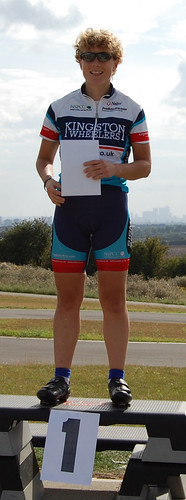
As I've been forced to watch many others pass me by -- quite literally, as every cyclist on a road bike these days overtakes me -- it's been interesting to contemplate this dramatic fall in speed and power and think about my journey through various training partners since I got pregnant. I hesitate to say "regression" though that's of course what it's been; it's nicer to think of it in terms of getting to know various folks in the club as I join them on rides I'd have rarely done otherwise.

Pre-pregnancy to week 6
Still riding lots with Jim and the other 2nd/3rd cat racers in my club, which means hard training sessions and hammerfests that really push my limits at times. Club runs are those of the more social variety as recovery and mental health rides, where I hold back a lot on the flats and drop most people on the climbs whether I'm trying to or not. In other words, I'm in pretty peak form.

Weeks 6-18
The sudden influx of morning sickness means faster-paced club runs are about as hard as I care to ride. Full of fit guys and girls, not road racers but strong TTers and hardened sportivers nonetheless, up for pushing the effort from time to time but mostly wanting a steady good-paced ride and that suits me fine. It's touch and go at times, and I end up doing a lot of solo rides as I just can't tell on any given day how good or bad I'll feel or if I'll want to bail after an hour. But by the end of November I'm still going pretty well, having only gained a few kgs. We hold a club race skills training day at Hillingdon and the 4-lap scratch race at the end turns out to be more fun than I thought. Things are looking up, and when the snow flies just before Christmas I'm out on the cross bike having a blast. Racing has gone out the window though, after a few half-hearted attempts at cross and getting too depressed with how slow I am, I decide my season is officially done, and I'm now sucking the wheels of those fit guys and girls starting their winter training periods.

Weeks 19-29
I'm feeling much better, more or less back to normal, though the weight is piling on and this is having some adverse effects. "Club run pace" is the default for me now, with the occasional burn-up at the end. Raising my stem about 2cm helps accommodate the growing bulk in my midsection, but I find myself having to reach down and physically shift my belly upwards to get comfortable on the bike as occasionally I get a side stitch or ache from the awkwardness of it. I buy an 11-32 cassette (eschewing the 11-34 thinking I'll never want a 34-tooth cog... ha ha, how naive is that!), prompting the guys at Sigma Sport to refer to it as the "maternity cassette". Nonetheless, my ego gets a shock when I end up having to get off and walk up the last 200m of steep and nasty Pebblehill Road near Boxhill. Still, it's going well and I'm actually gaining fitness back, able to do long rides of over four hours and 100km as long as I can stop to pee every hour!

In fact in March I do more miles than I have since the previous July, helped by numerous midweek "work dodgers" rides with fellow Wheelers who are off work or working strange shifts. Of course, the average speed is a lot slower and towards the latter weeks I find myself deliberately avoiding routes with steeper hills. The top corner of Coombe Road, or the steep early section of Crocknorth is about all I can manage now. It's starting to get more than frustrating being dropped up every hill, no matter the gradient, by average club run pace folks, but I can still hold my own on the rollers and flat sections. Ironically, descending becomes more fun and secure with the extra weight, not to mention faster! I'm still leading club runs but generally from 3rd wheel shouting out the turns rather than sitting on the front a lot myself. Clubmates are starting to make jokes about whether they should be prepared to deliver a baby on a ride, and any time I fall to the back of the group I'm met with concerned looks and questions of whether I'm feeling all right.

Weeks 30-?
The end of March sees me off the bike for an entire week as I juggle all the tasks of moving into a new house and getting out of the old flat. The movers come and I can barely go up two flights of stairs empty-handed let alone lift or move many boxes. It's shocking how breathless I've suddenly become, and how quickly my heart races with any small effort. Finally a few days after moving into the new house I get out for a glorious sunny ride and manage 22km/h average speed for the first hour. Three hours later I make it home quite exhausted and I have to admit my 100km riding days are over for now. Club runs now see me volunteering to lead the "newbie" ride, with its slow pace on the flats and even slower pace up the hills (I'm last up the two shallowest hills we ride -- the so-called backmarker -- and get dropped easily now on the smallest of rollers). Richmond Park laps are of the TT-course variety, avoiding both Dark Hill at Kingston gate and Test hill near Robin Hood gate. Any headwind on a hill sees me slow to a virtual crawl. Where's that 34-tooth cog I should have bought!

Worst of all, I no longer have any mental desire to work hard, and my legs feel like jelly if I do. My HR shoots up so high with any effort that I have to ease off otherwise I feel sick. It's like the first trimester all over again, only 25lbs heavier. Riding has become about getting out for some sun and fresh air, and all thoughts of power or speed or effort are completely gone. It's hard to guess what my FTP might be, but I suspect I could not hold more than 175w for an hour these days. Luckily I can diesel along at 130w for several hours still, but I'm getting less and less motivated to ride, and more and more fearful of hills. Still, I'm pretty stubborn and have yet to pull out my upright old MTB for a last-ditch resort to ride on the flat towpaths. Even as I see my CTL drop again (after hitting a max of 85 in week 29) I can't be too fussed about it. Even with the nice weather, I just don't feel like riding much anymore. Though at least I still have a few training partners left, the guys who are coming back from injury or extended lay-offs or just plain fat unfit cabbies (you know who you are!)

The final weeks
This is where it all becomes a mystery. I had said I wanted to keep riding til my birthday which would be the end of the 37th week, but that's looking like a big ask now. To be honest, I'd be happy to go into labour by then! A few weeks early is starting to look like a great plan. In the meantime I'll have to start making plans to stay active somehow. The pool is seeming most likely, and brisk walking seems to feel like proper exercise. In fact, anything but sitting on the couch feels like work...

The future
Over the past several months I've gone through the whole gamut, from riding with the strongest and fittest members of my club to riding with the weakest. It's been strange to measure myself against others and watch the slow decline in performance, knowing that a group I join to ride with will soon be saying good-bye a short while later as they leave me behind. I can only hope that the months after the baby see me progressing back up through the groups, improving the way I declined til finally I can ride with Jim again at his speed. Though of course riding with Jim again is going to mean a whole new problem to solve for both of us! But it's something I've really missed so it's worth the effort to make it happen in the future, even for just a rare Sunday. Anyone want to baby-sit?

bikebump2
29 weeks
week33bike
33 weeks

Tuesday, 31 March 2009

The big Sports Nutrition post: the background

If transitions are the fourth discipline in triathlon, surely nutrition and hydration are the fifth. Get it right and you set yourself up for a great Ironman; get it wrong and you're bonking/dehydrating/vomiting/passing out all the way to a DNF.

So following some of Jim's musings and experiments in making his own energy gels, and my recent posts to the TriTalk and BikeRadar forums on sports nutrition, I figured it was time to blog some of my own thoughts and experiences about this very important and sometimes frustrating side of endurance athletics. In the second part, I've posted some tried and true recipes for various sports drinks and concoctions.

A bit of background

When I first started training seriously for triathlon in 2004, I had been more of less following the Zone way of eating for the past 5 years; that is, moderating my carbs, protein and fat intake in meals and snacks to be 40%, 30%, and 30% respectively. I had found this was the best way both to eat well (lots of veggies and lean meats with a moderate amount of "good" fats) and to control my appetite and blood sugar to avoid those afternoon dips. In fact, I had gotten good enough at that way of eating that I switched to decaf coffee shortly after starting on the Zone, and never looked back.

The problem is, the Zone diet was designed for ordinary (okay, probably even overweight) people, living normal mostly-sedentary lives and needing a way to control their weight and blood sugar. It wasn't designed for athletes, and especially not for endurance athletes. Its negative skew of all things sugary meant that I started out as a triathlete thinking I needed to avoid taking in excess carbs in the form of sugar, and sticking to my 40-30-30 calorie distribution. Of course, this is only really applicable in the hours outside of training and its immediate recovery period. For time spent exercising and the 2 hours directly afterwards, a much higher concentration of carbs is needed in the diet. And the longer you train, the more important it is both to ingest enough calories during exercise and to recover well with enough calories afterward.


The Research

So I started Googling and reading about it. A friend gave me a free can of Accelerade and I used it as a recovery drink, finding that I suddenly felt much more refreshed the next day. I started buying all the different gels I saw at my favourite Canadian cycling/running store and trying them out. I looked at the ingredients of various sports nutrition drinks, researched what they did and how they worked, and started experimenting with making some myself. Given the simplicity of the ingredients and exorbitant expense of the store-bought ones (and with my unpredictable income as a freelance film industry worker), I was happy to invest some time and energy into a cheap and workable solution to my energy needs.

Right away I learned that simple sugars such as those found in Gatorade and most during-exercise sports nutrition products (glucose, dextrose and fructose) needed to be mixed in lower concentrations in order to prevent stomach upset, and that they tended to produce severe blood sugar spikes. With my sensitive stomach and history of rollercoastering blood sugar, I was therefore drawn to Hammer Nutrition, whose products contain only complex carbs in the form of maltodextrin (which produces a more even insulin reaction and can be mixed in higher concentration due to its greater osmolality). I browsed their website, read a bunch of their articles ("10 Biggest Mistakes Endurance Athletes Make", "15 Simple Ways to Improve Your Athletic Performance" , "Recovery - A Crucial Component for Athletic Success" and the mother of them all, "The Endurance Athlete's Guide to Success") and studied the nutritional info of their products. Then I set about trying to make my own.

The ingredients were pretty ordinary. Plain maltodextrin for short training sessions was easy to get at my local beer-brewing shop, and soy protein (needed for for longer training sessions) I found at the health food store. Whey protein and extra glutamine for my recovery drink was available at the sports supplement store. I managed to replicate electrolyte tablets and powders by mixing salt, lo-salt (containing potassium), calcium powder and magnesium powder in the appropriate ratio. Since moving to the UK, I've even found a source for powdered flavourings, so have said good-bye to the old unsweetened Kool-Aid packets. Jim has furthered the research into things like BCAAs and HMB, so that will be added to future versions of my concoctions as well.

The Current Favourites

Of course, since I started this sports nutrition project I've moved continents once, countries twice, been employed steadily making good money and gotten quite serious as an amateur athlete with Ironman Kona goals. So even though I still make my own training and recovery mixes -- particularly recovery mixes as that's where I don't need to worry about stomach sensitivity so much -- I also buy the following products regularly now from Hammer UK because I can afford it and because sometimes it's just easier. I should point out that unless otherwise noted, I always mix my drinks into a concentrated paste/liquid in a separate bottle or flask, so that I can isolate my water intake from my fuel intake.
  • Perpeteum - My staple for long bike rides including Ironman. The 8:1 soy protein/malto mix with added fat means it digests steadily and I don't get hunger pangs after 5-6 hours in the saddle. I'm going to try to replicate it using egg yolk powder for the fat as soy lecithin powder is not so readily available.
  • Hammer Gel - My staple for runs including marathons, as it's malto-based, easy to carry, easy to eat, doesn't upset my stomach, and comes in many different flavours, both in little packets and large jugs. Jim has a recipe for making gels like this but not a way to package them into one-serving foil wrappers (yet!)
  • Sustained Energy - The original endurance fuel, its 7:1 soy protein/malto ratio makes it a little less heavy in the stomach than Perpeteum. I've made my own and flavoured it with instant coffee granules to add some caffeine. Nice for medium-length rides or mixed half and half with Perp.
  • Heed - The basic carb-only sports drink, and my staple for short intense rides when it's logistically easier to combine my fuel and water into one bottle. It's got electrolytes added too, so great in summer.
  • Endurolytes -Electrolytes including Sodium, Calcium, Potassium, Magnesium in the ratio of 4:2:1:1 respectively. I prefer to use the capsules rather than add the powder to my mix, so that I can control my electrolyte intake better and top up quickly when necessary. I do add my own electrolyte mix to my recovery drink however.
  • Anti-Fatigue Caps - Various hard-to-find ingredients which act as scavengers for the ammonia that's a by-product of protein metabolism. The body burning protein is something that happens after about 2 hours of training, making this good for long rides and runs. Haven't been able to test it "scientifically" enough to say for sure that it works -- it might be a placebo effect after all! -- but it seems to help with muscle fatigue once I get over 4-5 hours in the saddle.
  • Energy Surge - Pure ATP which is what sprinters burn through. Probably not so useful for endurance events unless there's a big climb coming up or a sprint finish predicted. Haven't figured out how to take these little pills when I really need them, like in a cycling circuit or road race, without dropping or losing them. Maybe stuffed inside something solid like a wine gum? Jim likes them for running fast 5km races as they do give an instant kick.
and shortly to try
  • Race Day Boost - Sodium Phosphate "loading" and glycogen storage supplement for endurance events, to set up the blood to buffer lactic acid. Interested to see how/if it works, as lots of users rave about it. Can't seem to find pharmaceutical grade sodium phosphate anywhere, so I haven't been able to make it myself.
and possibly
  • Liquid Endurance - Glycerol loading for hot weather events, which lets your muscles store extra water. Since I no longer reside in the tropics of southern Ontario in the summer, I don't really need this unless we get an unexpected heatwave.
So without further adieu, here are the latest renditions of my recipes for various training and recovery mixes.

By the way, if you've been inspired by what I've written and want to order your own whey and carbo powders from MyProtein.co.uk, please use my referral code! MP107371

Saturday, 28 March 2009

A slight bout of taperitis

A week from tomorrow is my marathon, so last week I started to taper a bit. Having done some good volume in the past few weeks -- 100km bike rides and 2+ hour runs -- it's been nice to stick to short and fast workouts instead this week. The weather helped me too; going from beautiful warm sunny spring to crappy rainy windy spring seriously curbed my enthusiasm for going outside to train. But fewer hours trained is fewer calories burned, so to stay nice and lean for the race I've had to fight the munchies a bit. I think I'm winning the battle though, as after yesterday's hard 17km run and pasta dinner, I denied myself the bread and chips (er, crisps) I was craving around 9pm and this morning was rewarded with 54.6kg on the scale. That's the first time I have been below 55kg since I moved to the UK, and hopefully I can keep up both the motivation to train hard and the willpower to eat better with results like that!

For the run yesterday, I did the same route I'd done last fall 2 weeks out from the Nice marathon: a 2.5km warm-up run to Richmond Park, a hard loop of the 11.7km outer path in the park, then the same 2.5km run home to cool down. In the fall I had run the loop clockwise (tailwind on the open flat, but ascending the steep hill) in just under 57 minutes. Yesterday in my super fast Asics Gel Banditos shoes and running counterclockwise (descending the steep hill but with a brutal headwind on the open flat), I managed 52:57! That's a 4:31/km pace, running on hard-packed dirt with 75m of elevation gain/loss, and it gave me a PB for 15km if the Garmin is to be believed. Needless to say, I was quite happy given that my last few longish runs have been somewhat painful and disheartening.

SportTracks has some cool plugins and one of them is the Map Overlay, which colours the track on the map to show different speeds, gradients, heart rates, etc. Ever the numbers and maps geek, I find it quite interesting to see where my pace slows down and speeds up relative to hills, headwinds and distance. Glad to see I finished strong in the last little uphill bit because by then I certainly wasn't feeling strong!


As for the marathon, I still haven't decided whether I should run the full distance or not, but I'm hoping that I feel good enough on the day to give it a go. I'll gauge it during my warmup and in the first few minutes of the race, and if I feel anything but completely rested and 100% ready to tackle 42.2km, I'll speed up and try to run a strong PB in the half instead.

Monday, 9 March 2009

Training volume + weight loss = getting sick more often?

Since my training year officially started the week of January 1, I've been trying more or less to improve my eating habits (i.e., eat less food in general, and less junk food in particular) and lose a bit of weight. Not lots, just the icing off the cake so to speak. According to popular research, each pound lost is a minute gained in a marathon, and of course climbing well on the bike is all about being lightweight.

After reading that Dutch pro triathlete and 2008 Kona runner-up Yvonne van Vlerken lost 4kg last year off her "athletic frame" (what a nice way to say short and stocky), improving her speed and performance, I figured losing the same would go a long way to achieving my Kona dream too. As of January 1, my own 5'2" athletic frame weighed over 57kg. The goal is to get down to 52kg for race day, August 2.

Right now, in mid-March, I'm at about 55.5kg. This is the lightest I've ever been in March and it shows -- my jeans are a bit loose now in the waist (though tight in the upper legs thanks to all those 14% hills I've been riding!) -- and I feel pretty toned. Since I don't have a body fat monitor, I have to use a combination of the scale, how I look in the mirror, and how my clothes fit, but I would say that even though I've been putting on muscle from all this running, cycling, upper body weights and core work, my body fat is still down. Apparently I'm now considered a hot roadie even, although I think there's a bias there....

In late January, we had a little holiday on Lanzarote to kick start the season with some high volume bike training, and as usual when we got back I promptly came down with a cold. No worries, within a few days of rest and reduced intensity training I was over it and back to the regular grind. Since then I've steadily ramped up my training volume to an average of 12 hours a week. I've been eating well, recovering well, sleeping mostly well (though never enough, it seems), and feeling fast, sleek and great. Strong as an ox, right?

Last week I had some shorter workouts with higher intensity, then the plan for the weekend was higher volume at lower intensity. Friday afternoon I ran 28 hilly km in 2:20, Saturday I rode 60km on flat terrain in zone 1/2, and yesterday was a 90km group ride with 750m of climbing spread over 3 major hills that I attacked reasonably hard, with the rest of the ride pretty easy. Came home, threw on my recovery tights, ate a good meal, and lazed in front of the TV for most of the evening. I even managed to make it to bed before 11pm as I was feeling a bit tired from 8 hours of training over the past 48 hours. But by 2am I was up and sneezing, coughing, completely congested... with what seems to be another cold.

My resting HR this morning was normal, so obviously I'm not too sick. Today's a scheduled easy day with just a short form run anyway, along with some core and upper body work at the gym that I may push til tomorrow. So I'm not too worried, but I am a bit frustrated and wondering what's up with my getting sick so often. This is my third cold in 5 months, and for someone who has more than once gone an entire year without a cold, that's pretty bad! Is it the weather in my adopted country? My increased training volume? My slimmed down physique? The fact that I'm now living full-time with a (wonderful and loving) night owl and poor sleeper? All of the above?

SportTracks has a great little plug-in called Training Load, which is basically a poor man's Training Peaks for those of us who don't have a power meter (yet!) It takes the time spent in various HR zones and intensities for training activities and calculates a TSS score for each, then graphs CTL, ATL and TSS over time. This is what mine looked like this morning:

Training Load 2009-03-09

blue = CTL aka fitness level
red = ATL aka fatigue level
pink = body weight
brown columns = the TSS or Training Stress Score for a given day's activities with general scales of low, medium, high and epic.

The "epic" event and accompanying spike on the farthest left is the marathon I ran on November 9, 2008. The following month I took it pretty easy as evidenced by the drop in both ATL and CTL, then got going again with serious training in the new year. The big jump in the middle-right, and corresponding drop in body weight is the Lanzarote trip. Since then my fitness has been steadily climbing, my fatigue is being managed through easy days and days off, and my weight has been dropping.

It's nice to see my hard work translated into pretty graphs showing improved fitness (being the data geek that I am), but I'm starting to wonder if 52kg is going to be too light to be both fit enough and strong enough for Ironman UK. Do I really have 3.5 more kg to lose, or is the risk of illness too great? If I keep going the way I am, I'll lose that weight just from maintaining my current diet and ramping up the volume in early summer when I start doing 5-6 hour rides. At that point, I guess I'll find out whether I get to eat -- must eat, even -- all the dessert I want again, just to stay well!