Showing posts with label time trial. Show all posts

Saturday, 18 June 2011

New Beginnings

I should have known that going out and buying a swimsuit appropriate for my 9-months-pregnant body would mean I'd use it once and promptly go into labour. And that's exactly what happened, I went for a swim on Monday night, the day after my due date, and that night woke up in a puddle. Four days of latent labour, full waters being broken, induction leading to the most pain I've ever felt in my life, and a c-section later, we had our little one, a girl we've named Otter. She weighed 8lbs 9oz at birth, but at only 19 inches long it's looking like she takes after short stocky me rather than tall lanky Jim. She was a superstar throughout the entire labour, her HR very steady and showing no distress, and scoring a 9 out of 10 on the one-minute Apgar test (10 out of 10 at five minutes). In fact, she appears to be very strong and fit and the midwives have nothing but compliments for us.

Despite a stressful and tiring labour for me -- both physically and emotionally -- I'm recovering well (something I chalk up to my great fitness going into it) and already looking forward to when I can get on my bike again. I'll give it another week then start out with gentle spinning on the turbo and see how it goes. My CTL has already plummetted to below 50 in the short time I've been off the bike, with more to lose before I can start back again, but that was to be expected.

Otter at 24hrs old
Otter at 24hrs old

Just in case it sounds like I'm bragging or overconfident or anything... let it be known that I'm really just getting through each day as it comes, trying to catch sleep when I can, nursing very sore nipples (and massive knockers, wahey!) and generally letting Otter lead me as to what she needs and when. Having a newborn glued to you nearly 24/7 is quite a bit harder than I imagined. When Jim goes back to work next week it'll be even more challenging. But it seems Otter is a pretty easy baby so there's that to be thankful for at least!

Gurning
I have no idea what I'm doing!

So over the next little while, I'll be doing more supporting than riding while Jim does a few TTs he's entered. I'll have to live my racing life a bit vicariously through him, though I hope myself to manage a 10-mile TT by end of summer, then a few hill climbs. Racing a crit isn't out of the question but I'm not holding myself to it. Longer road races are quite unlikely as I just won't have the time to train for or race them well. Instead I'll dig out my running shoes again and start to build up the miles there for the autumn cross-country season. Once Otter is big enough to go in a jogger, we'll buy one. But I think a bike seat is still a long ways off!


My favourite view of Jim in TT mode

Sunday, 3 October 2010

Hell Climbing, I mean, Hill Climbing Joy


(courtesy of clubmate Nick Hussey)

I sort of fancy myself a climber, though in reality I'm more of a pint-sized rouleur than a lightweight grimpeur. Still, when the road goes up I tend to do well, so what better way to top off a fine racing season than to try some hill climbing time trials?

Mistake #1: hill climbing is nothing like climbing a hill in a race. Following wheels, attacking off the front, marking others' attacks and setting tempo on the front are all completely different from the all-out lung busting effort that is a typical UK hill climb (more or less five minutes at ~10%). Rarely will you find me at my all-out 5-minute power for longer than a minute or two in a road race unless it's the final few minutes. And most importantly, the pyschological distraction and stress of other riders makes climbing at that intensity in a road race quite a bit more tolerable.

Mistake #2: pacing is pretty crucial. Going out even a bit too hard will be repaid in a thousand agonies. If the race is a short two or three minutes, you might get lucky; at least it's over quick. But for anything longer than five minutes, pacing is really important.

Mistake #3: underestimating how badly it will hurt. I've done three hill climbs now and I feel I've learned a huge amount between the first and the third, but the one thing that hasn't changed is how awful it feels while you're doing it. Proper pacing makes it manageable but that wheezing chesty cough still happens after every one. I have yet to puke at the top so maybe I'm not going hard enough though?

So what is a hill climb about? It's the most intense experience of time-trialling that exists. It's all you and nothing but you out there. The clock is ticking somewhere far away, but in the here and now it's just you... suffering, hearing your own ragged breathing, struggling to turn over the pedals, thinking how badly you're doing, wondering when it will end. If you're lucky you'll see someone ahead of you floundering even worse and use it as mean motivation; if you're unlucky you'll be overtaken by your minute man which only serves to dampen further any enthusiasm you have for hill climbing. The final seconds are a sweet respite as the sight of the finish line promises relief that this will finally be over.

But it's cruelly deceptive, as the first few seconds after the race is over are nearly more painful than the race itself. Gasping for breath, legs jellified, skin tingling, brain insisting that you never do one of these again! All of which disappear in the next minute or two leaving you feeling exhilarated and full of adrenaline. And those feelings last long enough to sign up for the next one.


Me climbing through cowbell corner at the John Bornhoft Memorial Hill Climb (courtesy of clubmate Rich Allen)

Sunday, 25 April 2010

FTP and the 25-mile TT benchmark

Today I completed my second ever 25-mile time trial on the roundabout-filled and rolling G53/25 course. This is an interesting distance to race due to its association with that hallmark measurement of fitness and performance: FTP or functional threshold power. With the advent of powermeters on bikes, someone decided that the power you can put out for approximately an hour (coincidentally the length of time a 25-mile or 40km TT lasts for a reasonably fit rider) should be the benchmark for measuring all other power outputs. Thus, all other performance and fitness factors are a function of that one-hour power, with paces and levels described as a percentage of FTP. So a Training Stress Score (TSS) of 100 is defined as one hour at FTP, and an Intensity Factor (IF) of 1.0 is when your power output is 100% FTP.

I've often thought about whether this system of testing and evaluation power is really accurate for most riders, since few of us ride 60 minutes at a steady state in an all-out effort very often. Yet this magical number is how I and WKO measure my effort and fatigue from all other workouts, both short and long. I suppose it's like anything: you need to train it to be good at it, so if I actually did lots of steady-state intervals at FTP like Coggan suggests, maybe my one-hour power would reflect that. But since I don't, I've had to use other measures to figure out my FTP. And it turns out that the FTP I've been using to define my training is actually a bit lower than what I can actually put out for a 25 mile time trial.

Last autumn when I did my 25 mile TT for the first time, I had my FTP set at 240 watts. This was based on a number of races I had done, intervals I could hold in training, etc. I showed up at the TT on the knife edge of fatigue, merely a few weeks before Kona. And managed to put down a time of 1:00:49 with 221 watts normative power, 218 watts average power. A full 15 watts fewer than I "should" have been able to do! Hmm.

I don't think I overestimated my FTP too much, maybe by 5 watts or so. A few weeks earlier I had done a 10-mile TT (~105% of FTP) on 254 watts so had based my numbers in part on that. Had I been fully rested, I might have been able to hit that 240 watts, or had I been doing Olympic distance triathlon training instead of Ironman, or, or, or... anyway, suffice it to say, I let my fitness tail off after Kona and at Christmas I was back down to an estimated FTP of 220 watts, to be built back up between January and March via cyclocross, winter circuit races and a warm-weather training camp spent on the Canary Islands.

Today I showed up -- same course, same time of day, same air temperature and conditions more or less, same equipment more or less, same lack of sleep, though I was less fatigued overall -- and put down a 1:01:59 with 225 watts normative power and 223 watts average power. The rain halfway through and subsequent windier conditions probably was the biggest factor in the slower time (the winner of both races who happened to be the same guy was also 90 seconds slower), though I also wriggled around a lot and cost myself some aerodynamic advantage, having not ridden my TT bike in a while and not being entirely comfortable on it. Yet I still fell 10 watts short of my current estimated FTP, which is set at 235 watts these days and I think is pretty close to reality.

No excuses this time (apart from the wriggling), but again it leaves me wondering who out there can actually ride 60 minutes straight at a completely steady effort at their WKO-estimated FTP. Yes, I could set my FTP lower, but then all my other intervals -- particularly the shorter ones -- would be overestimated, thus inflating my IF and TSS for every other workout. So this is the flaw in WKO+ I think: basically your single biggest benchmark by which all effort is measured is somewhat impossible to actually achieve! Unless of couse you race 25 mile TTs all the time. Does anyone else have this problem?

At any rate I was pleased to see an overall increase in today's race of 5 watts over last time, meaning that my fitness is pretty much at the same place it was last September when I was peaking for Ironman Kona. And it's still April! Lots of summer racing to come. For future FTP tests I'll be more likely to go out and do a Richmond Park 3LC some nice evening. Same ~60-min effort and a lot closer to home!

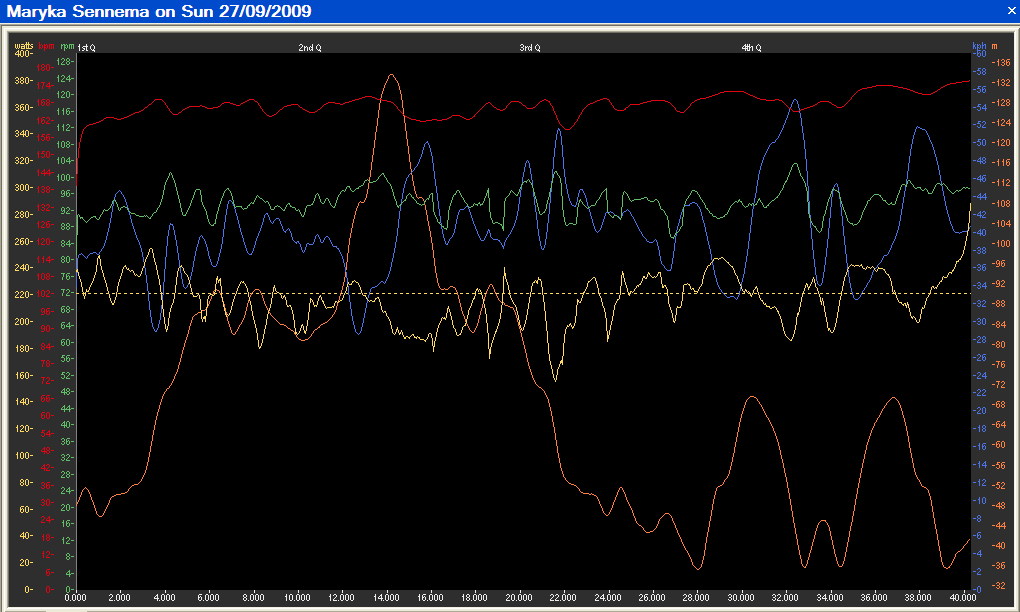
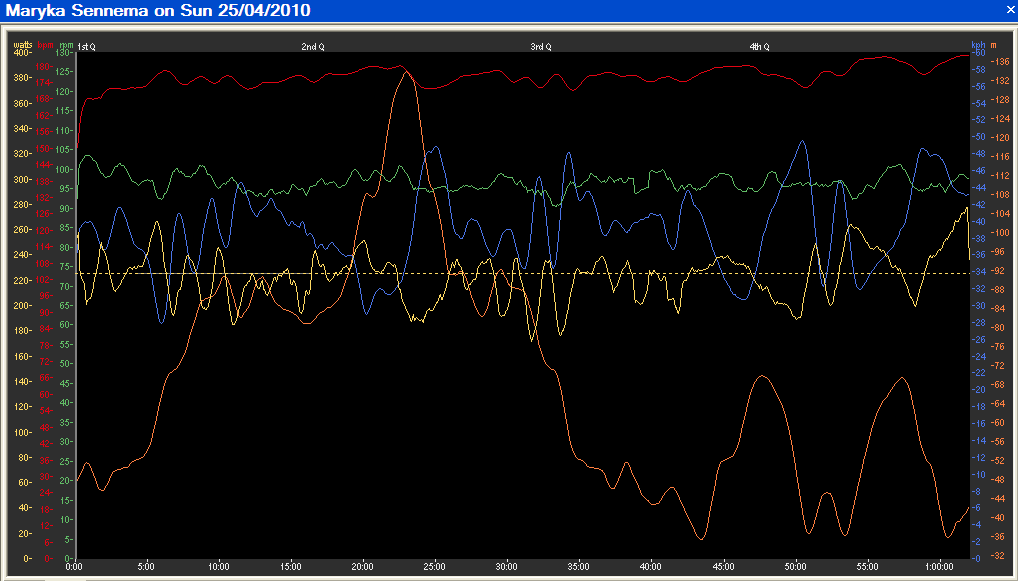
Below is a graphical comparison of the September 2009 and April 2010 time trials (the grid line shows the average watts for each race). Both were paced reasonably well, both contained an obvious dip halfway through as I felt the effects of the effort, and both started out perhaps a bit strongly. Today's effort showed a better recovery and kick through the last quarter of the race, and also shows how much less fatigued my overall state was, with an average HR of nearly 10 beats higher! Otherwise, the slower speeds on the downhills show the headwind today; you'd never know I had a disc cover on there.


200909TT

September 27, 2009
Lap 1 (1:00:49.15):
Duration: 1:00:49 (1:00:57)
Work: 796 kJ
TSS: 85.9 (intensity factor 0.921)
Norm Power: 221
VI: 1.01
Pw:HR: -0.28%
Pa:HR: -4.76%
Distance: 40.329 km
Elevation Gain: 412 m
Elevation Loss: 417 m
Grade: -0.0 % (-5 m)
Min Max Avg
Power: 0 389 218 watts
Heart Rate: 98 176 167 bpm
Cadence: 47 131 94 rpm
Speed: 0.3 57.4 39.8 kph
Altitude: 32 137 69 m
Crank Torque: 0 60.9 22.2 N-m


201004TT

April 25, 2010
Lap 1 (1:01:58.01):
Duration: 1:01:58 (1:02:06)
Work: 828 kJ
TSS: 95 (intensity factor 0.959)
Norm Power: 225
VI: 1.01
Pw:HR: 0.75%
Pa:HR: -2.91%
Distance: 40.35 km
Elevation Gain: 417 m
Elevation Loss: 421 m
Grade: -0.0 % (-5 m)
Min Max Avg
Power: 0 656 223 watts
Heart Rate: 117 184 176 bpm
Cadence: 53 123 97 rpm
Speed: 1.4 59.1 39.1 kph
Altitude: 32 137 69 m
Crank Torque: 0 103.2 22.0 N-m

Monday, 1 February 2010

Maps: Riding and Racing in SE England

I use Google Maps a lot to find my way to places or give directions to others. While I tend to stick with BikeRouteToaster to create specific cycling routes for upload to the Garmin 705, Google Maps is great for larger-scale projects and collaborative efforts. Here are three I've been working on lately.

The Surrey Hills Project
This was started by a Kingston Wheelers clubmate as a list of the climbs in the Surrey Hills, but soon grew to include tea and cake stops as well. Still a work in progress!


View Surrey Hills Project... in a larger map

Triathlon/Time Trial Training Routes
Last year when I was training for my Ironman races, I struggled to find flattish, straightish, good quality roads without too much traffic. I eventually came up with some useful routes for longer rides, as well as a few others for shorter intervals or testing my aero position. And also where not to go!


View TT training routes in a larger map

Local Cycle Racing Circuits
With the race season starting up again and some new riders in our club getting into racing, I figured I'd map all the local closed-circuit courses in and around London. There are only a few on there so far, but if I get ambitious I'll add some of the open road circuits, TT circuits and cyclocross locales as well.


View Cycle Racing Circuits in SE England in a larger map