Showing posts with label tapering. Show all posts

Thursday, 8 October 2009

Kona Pics

Figured I should finally get around to writing about Kona itself and my experience so far, and post some pics for people to enjoy. I feel in some ways that being here for the race and spending so much of my time and energy living Ironman that I haven't been a proper tourist so to speak. I've certainly left my camera at home more often than not! But I've still managed to see and do some things, as evidenced below. Here's a mishmash of sights seen, both triathlon and non-triathlon related.

Every day from sunrise to sunset, athletes can be seen swimming at Dig Me Beach, aka the start of the swim course at the pier. I've been there a few times myself, usually around 7am when it's the busiest. Last week it was pretty quiet; come Monday it was crowded and busy with a bag check-in, free swag and tons of glistening muscled bodies in Speedos everywhere. Speedos are nearly outnumbered by speedsuits by now, but not quite! On race morning I'm sure speedsuits will be the order of the day.

Swimpractice_small
Lots of athletes gather at the beach, many leaving their $5,000 bikes unsecured in the racks nearby.

calmswimcourse_small
A view of the practice course, curving around the orange markers parallel to shore.

Coffeeboat_small
This week the floating Coffees of Kona espresso bar appeared, handing free coffee out to anyone who swam the 700m to the boat.

saltwatergross_small
I tried out my new speedsuit (which is indeed speedy!) but all the coffee in the world can't take away that awful warm saltwater taste.

lavajava_small
Afterwards, this iconic cafe is the main attraction for many people (the guy riding on the bike is one of hundreds who will pass by during the day).

Earlier in the week, we went snorkelling at Puʻuhonua o Hōnaunau National Historical Park, aka the Place of Refuge and found this little guy getting a few swim lessons of his own. At 10 weeks old, he wasn't too fond of the water!

dogswimlesson_small
The big dog tried to show him how, but he just wouldn't get off that rock.

Cruise ships come to Kona every few days, full of (ahem) more average-sized Americans or Australians who stand out like a sore thumb against the backdrop of 1800 fit and ripped Ironman athletes. This one was about to pull away for another night of cruising the ocean.

cruiseshipsunset_small
Like a giant floating city of its own.

The finish line isn't set up yet, but this sign stands here year round. It's right next to the swim start, but seeing as the actual sign is about 4 feet above my head, we had to photoshop this pic a bit to fit it in.

Kona_IM_sign_small
That's King Kamehameha, the first Hawaiian king, on the sign, by the way.

Jim and I finding some shade and breeze from the relentless 31 degree heat made worse by the strong sun here. One of the coolest things about Kona is how much "indoor" stuff is outside, like the airport gate waiting areas and baggage belts, and hotel check-in desks. All are covered in case of rain, but temps of 20-35 degrees year round mean outdoors is always comfortable if you're out of the sun.

JnM_small
Having been sunburned already, we weren't taking any more chances!

I registered today and got all my kit and wristband. Every age group gets its own colour, meaning I'm checking out the wrists of every female athlete I see, sizing up my competition. Ironically, I'm neither representing Canada nor Great Britain; instead I'm one of only threes Dutch women here, the other being last year's 2nd place pro Yvonne van Vlerken and handcyclist Monique van der Vorst.

wristband_small
Blue is my favourite colour, so I'm hoping this lovely blue wristband is a good omen?

And finally, my bike is primed and ready, just need to attach the number plate and put the bottles on. Aero helmet is a go after I discovered that my brains were frying under my regular helmet too. My position is so aggressive that every fast-looking guy I passed going the other way on the road the other day had a long good look at me... so apparently I must look like I'm good at least!

P3Cready_small
The mean machine ready to eat up those miles.

Wednesday, 7 October 2009

Postcard from Kona

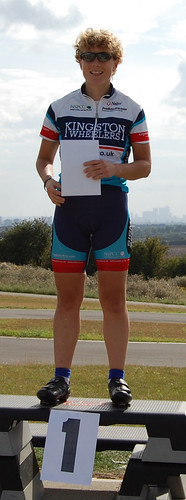
In keeping with my lack of blogging myself and instead writing for other sites, my club the Kingston Wheelers has published a little blurb I wrote in a rather introspective moment in Kona (complete with a photo that's only a tiny bit photoshopped, ha ha. Those familiar with Kona will know what I mean!)

Here's what I wrote:

It's now halfway between our arrival to Kona and race day, and I actually feel normal again. Jetlag from the 24-hour trip - and along with it an 11-hour timezone shift - have passed, though we still rise every day before 6.00am: early mornings are the best part of the day here. We've been surrounded by fit, fast, and bronze-bodied triathletes since we left Heathrow, sharing our flight with over a dozen other competitors judging from all the bike boxes that were unloaded at LAX. The flight to Kona was entirely filled with people sporting Ironman finisher's shirts and M-dot tattoos, and every day more arrive here to enhance any feelings of insecurity or inadequacy I might have had about this race. That girl running 6-minute miles, is she in my age group? That guy motorpacing, surely he's a pro? TT bikes outnumber every other type of bike 10-to-1. Not a minute goes by without someone running down the road past our flat, and on the highway it's one cyclist after another, all riding alone in full aero mode. Mornings at the beach are packed with people swimming the course, followed by the required breakfast at the iconic Lava Java bistro. It's all a bit overwhelming... and it's not even race week yet!

So today instead of wrestling my bike through 40mph crosswinds, running in 30 degree heat or swimming mile after mile with the tropical fish -- all of which I've done in the past few days - we took a day just to be tourists. With a rented boogie board we headed to the beach where I tried my hand at surfing with the local kids while Jim sat in the shade with his book. It was a welcome relief from the constant reminder that everyone here for this race is just as fit and ready as you are, with the speed, body and kit to prove it.

Any training I do from now on will just be to satisfy my mind and keep my body reminded that there's a race to come. I've come to know the course, I've steeled myself for the relentless heat and wind that are hallmarks of Ironman Hawaii, and I've made sure everything I can do to prepare has been done. Now it's just a waiting game until Saturday when all of us line up at the start, eyeing each other warily and wondering who will have the race of their lives and who will be reduced to a cramping shuffling mess by the finish. Needless to say, the former is the only option for me!


More to come later, with photos I hope, as I go to town to register and check out the expo. Nothing planned but a short run today, otherwise it's IM tourist time!

Wednesday, 23 September 2009

Peaking and Tapering, Part III (the triathlete's dilemma)

Having written Part I musing over my taper for Ironman Lake Placid, and Part II about how I was going to fix this problem for Ironman Kona, I recently stumbled upon some important information leading me to post Part III: the triathlete's dilemma. Thanks to the Endurance Nation folks for starting this discussion (maybe it will get moved to a Hall of Fame thread so the public can read it too) and to Russ Cox for helping me out by analysing his own numbers. In fact, I'm looking forward to meeting up with Russ in Kona for an evening of number-crunching geekiness as we try to work out how and why a good taper works.

The dilemma is this: in triathlon, you do three sports. At the Ironman level, I think we can assume most people swim a reasonable amount but not enough to have a severe impact on their training stress. Huge amounts of swimming just aren't a good return on investment for time spent training vs. time gained in the race. So that leaves us with cycling and running. Running tends to be harder on the body, requiring more recovery for most people after intense or long workouts. Cycling can be done in larger volumes and for longer periods at a time, as the impact on the joints is not as great. Thus the fatigue and associated recovery time from running is likely different than the fatigue and recovery from cycling. So the question is, why do we measure ATL (fatigue) on the same scale for both cycling and running? And more importantly, why would you want to pay much attention to a combined Training Stress Balance when that could hide vast differences in fatigue between the two? The answer is, you don't.

Once I had this "a-ha" moment, I looked back at my IMLP taper and sure enough, my TSB was +33, but that consisted of a bike TSB of +26, while the run TSB was a mere +7. In other words, no wonder my legs felt fatigued out there, my run was not nearly tapered enough! Too much running in the week or two leading up to the race led to this, which was caused by my blindly following my plan without thinking that my mileage up to that point had actually been below what the plan called for. Running 3-4 hours a week in training, then tapering by running 2-3 is not that smart. But low-mileage running is a topic for another post.

I haven't found much information yet on the "ideal" CTL, ATL and TSB numbers for the run vs. the bike in Ironman tapering (though digging through the Google Wattage list and other blogs has got me a bit closer to understanding it), but using Russ's numbers it looks like a run TSB of +15 or so worked for him. I'm aiming for a +12 on race day. I've also adjusted my run ATL to a 10-day constant rather than 7-day as I have on the bike. Wary that I backed off too much on the bike for IMLP, my bike TSB on race day in Kona will be +19 and I'm trying to limit my CTL losses to 13-14%.

See my charts below for the way it's going to look. Note that my TSB will be steadily climbing, rather than seesawing as it did for IMLP, and likewise my ATL and CTL steadily falling. And apologies for mixing and matching Performance Management charts from both SportTracks and WKO+. I finally spent a painstaking evening putting all my workouts between now and Oct. 10 into WKO+ and messing with the length/intensity of each to get what I believe now is a more ideal TSB. So the charts below reveal my new numbers:

run
TSB+12, CTL 37 to 30 for a loss of about 20% (that loss is perhaps still a bit high? but again, my run volume in general has been low compared to the intensity)

bike
TSB +19, CTL 85 to 73 for a loss of about 13-14% (TSB still a bit high, but we'll see how well I acclimatise to the heat and humidity in Hawaii)

total
TSB = +31, CTL 129 to 113 for an overall loss of 12-13%

runPMCedit

bikePMCedit

Thursday, 17 September 2009

Peaking and Tapering, Part II

In Part I, I talked about how (I felt) my taper wasn't quite right for Ironman Lake Placid. I've done more training hours, more consistent training, more intense training and more volume this year than in any year before, so my previous tried-and-true taper method also needed some reworking (it appears). For Ironman Hawaii, I'm going to be a bit stricter on myself in adhering to scheduled workouts in the last few weeks before the race -- both in the sense that I don't overdo it and I don't underdo it -- and hopefully I can have a better race day.

Ultimately, I want to use the Performance Management Chart (PMC) to plan my workouts to help me achieve two things by race day:
1) TBS of about +20
2) CTL loss of about 10% from its highest point.

To this end, the first thing I did was plug my proposed workouts for the next three weeks into SportTracks, along with their projected TSS values. Incidentally I find SportTracks with the Training Load plugin way easier than WKO+ to work with; the calendar makes sense, the notes field lets me add stuff seamlessly, and the general UI and feel of the software is so much more intuitive. And since I'm using TSS/TRIMP values to determine my training load and stress balance (the plugin by default uses HR), the PMC will look the same in WKO+ as in SportTracks -- just nicer. :)

I got my projected TSS values by looking at past similar workouts in WKO+. For instance, I know that a long ride of ~100km/4hrs at an intensity factor of .70 will give me about 200 TSS points. Similarly, an hour-long run including some mile repeats gives me a TSS of 100 or so. Swims I generally use one TSS point per minute, less if I swim easy and more if I swim hard.

Three weeks of workouts, including the final two weeks of peaking/tapering from my Endurance Nation plan, plugged into SportTracks gives me this for my PMC:

PMC
projected CTL/ATL for October 10, 2009

That's a CTL of 119 (down roughly 10% from a projected high of 131 on Sept. 29) and an ATL of 97 to give me a TSB of 22 the day before race day. The TSB is a bit high maybe. But it's also likely that my workouts will feel a bit harder once I get to Kona as I'll need to acclimatise a bit, so having a bit extra on the TSB should be fine. Interesting to compare it to my LP taper (the big drop leading up to July 26) and see how it drops off more gradually and with fewer ATL spikes until the final week.

It's an interesting balance, tapering to shed enough fatigue without losing too much fitness. The problem is, as TSB rises, CTL decreases which can mean more than 10% fitness loss on race day. So which one is more important, keeping to a no-more-than 10% fitness loss, or having a TSB of +20? I think this is probably a problem for most athletes who carry a high CTL: the higher your TSS/day (which is what CTL is), the more you have to do to maintain it. And the more severely you taper and cut your volume, the more CTL drops compared to its absolute highest.

The highly analytical article from Coggan describing the art and science behind the PMC is here, but in my view the most important sentence is this:
in the Performance Manager concept, an individual’s CTL (and the “composition” of the training resulting in that CTL – see more below) determines their performance potential (at least within limits), but their TSB influences their ability to fully express that potential. Their actual performance at any point in time will therefore depend on both their CTL and their TSB, but determining how much emphasis to accord to each is now a matter of trial-and-error/experience, not science.
But I think it's also important to keep in mind what ChuckieV has said about tapering and freshness (though I have to say he loses me with the "anyone training less than 15 hours a week only needs a few days of taper" bit!):
Quite often athletes erroneously aim for being "fresh" when Ironman day arrives, when they really just need to focus on being rested.
Rested is what I'm going to have to be to put on my best performance. That means early to bed every night, naps if I need them, limiting the time spent on my feet doing touristy things and generally staying away from the hustle and bustle of 2000+ other Ironman athletes stressing about their race.

Sunday, 6 September 2009

Peaking and Tapering, Part I

Yesterday I had an enlightening moment reading Joe Friel's blog about Projecting Race Readiness. I had known that my IMLP taper wasn't right, that I had tapered too much and lost too much fitness, resulting in a less-than-ideal race performance, but hadn't really crunched the numbers to see how. I had followed the protocol of 70% of usual volume in the first week of taper, 50% in the second week, 30% in the third week. Still, I felt flat and underpowered on race day and terrible compared to last year at Ironman Germany where I had tapered so carefully and hit race day feeling great.

Two things stood out for me in particular from Joe's post:
1. Training Stress Balance (TSB, or CTL minus ATL) should be about +20 by race day.
2. Total loss of Chronic Training Load (CTL, aka fitness) should be kept to about 10%.

I had a look at my own Performance Management Chart from WKO+ and checked out the numbers. Sure enough, between my taper start date of July 5 and race date of July 26, my CTL (blue line) had gone from 133 to 112, a 15% drop. And my TSB (yellow line) was over 30, way too high! Ironically, being more "rested" through a lower ATL (red line, aka fatigue) and higher TSB is the very thing that helped me feel slow and tired and flat during the race.

Tapering is certainly part art, part science, and there are a lot of factors that could have affected my race day readiness in Lake Placid. But from studying my data below, I can see clearly now how my drastically reduced training load -- too much too soon -- nearly blew my race though a poorly-executed peak period and taper.

PMC
How not to peak/taper

In Part II I'll take a stab at describing what my peak period and taper for Kona should look like, and what I'll do differently to achieve it (and in doing so, hopefully achieve a better race day freshness than I did at Lake Placid).

If you're not familiar with WKO+ and all the terms I've used, here's a basic crash course.