As most people who know me know, I love my Cervélos! My trusty Soloist, aka the Stealth Bike, has racked up thousands of miles as my bombproof all-season road and racing bike since I bought it new in May 2008. And the P3C is one of the most aerodynamic TT frames ever made, a
perennial favourite on the Ironman scene. Alas, once the P3C arrived
last June, my P2SL -- the first Cervélo I owned -- was reduced to mere frame and forks and relegated to a bag under the spare bed, awaiting a possible future as a fixed-gear track bike. So despite owning three Cervélos, but only two were ever fully-built and rideable. Until recently.
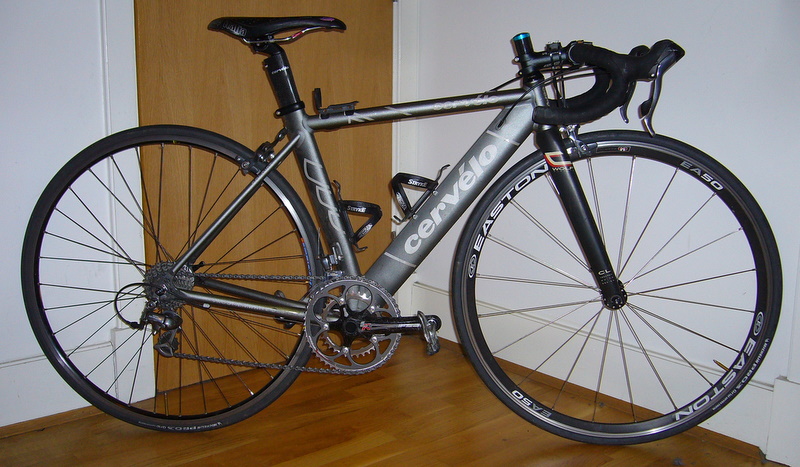 2008 Cervélo Soloist Team, 48cm
Jim and I had signed up for a couple of hilly Surrey League road races at Easter, but a persistent squeaking sound finally attributed to worn-out bearings meant his Powertap wheel would be at the repair shop over race weekend. With a 700c Powertap wheel on my Soloist and a 650c Powertap wheel on my TT bike, we had two Powertap wheels we could race with -- true data geeks would rather not race than be without a Powertap! -- but only if I built up the P2SL frame into a road race bike. I'm proud (embarrassed?) to say we had nearly all the spare parts lying around the house to do that, with only a front derailleur needed.
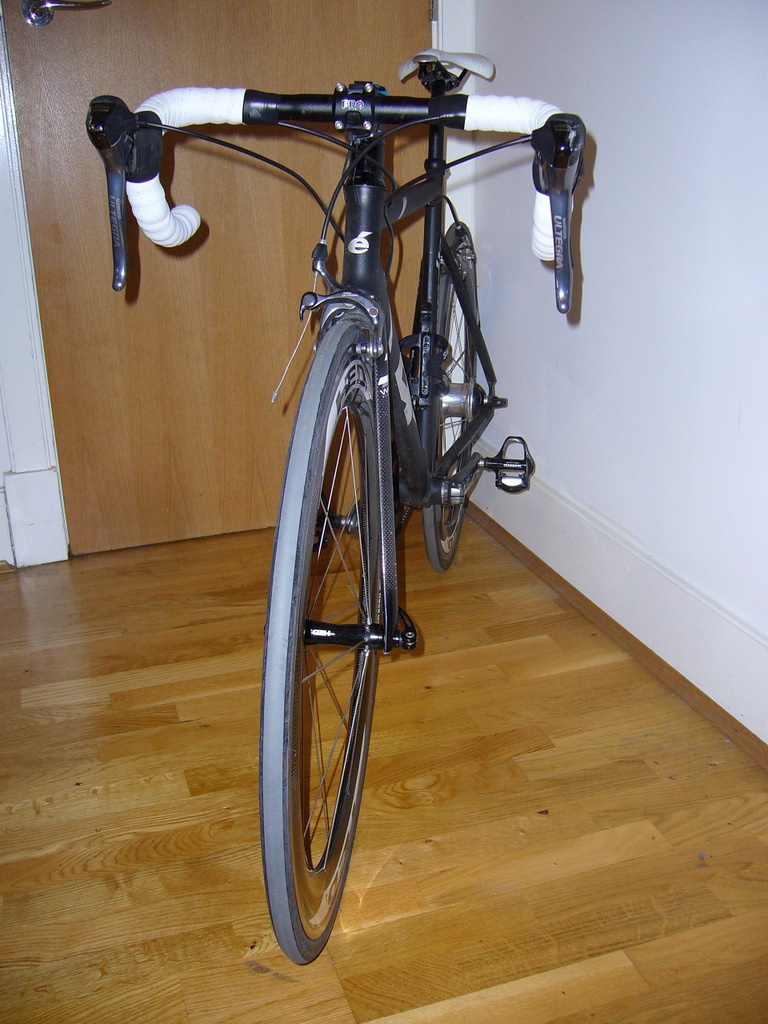
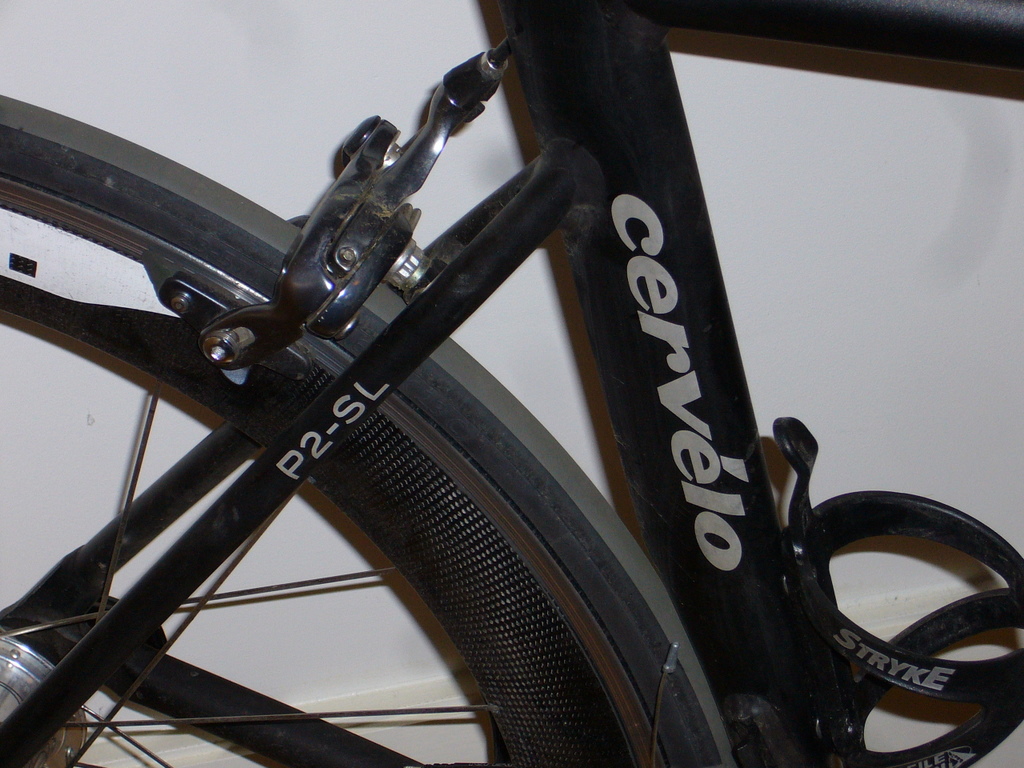
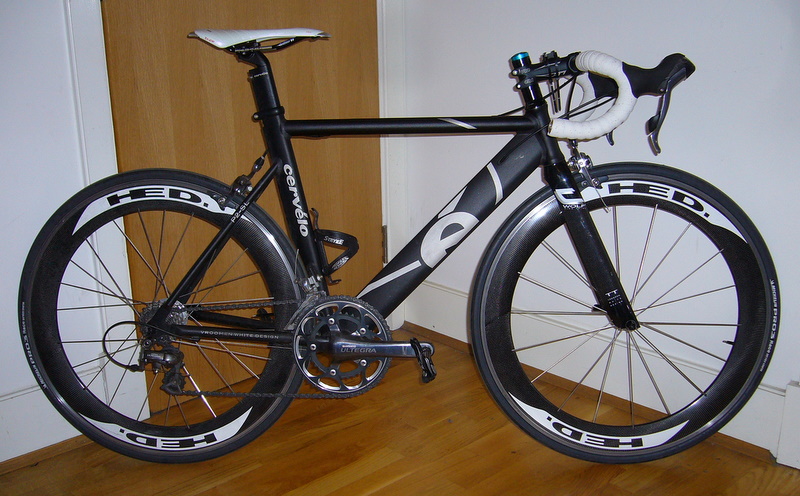 2006 Cervélo P2SL, 48cm
So I set about it two days before the first race, spending some time first studying the Cervélo geometry pages, then lining up the Soloist against the P2SL to try and replicate the position as best as possible. The first test rides revealed the need for a longer stem (and more comfortable saddle) but in the end I'm so glad Jim's Powertap died when it did, because without that impetus I might never have thought to put drop bars on the P2SL and race it. Instead, I now have an amazing little road machine that tops even the Soloist in agility and quickness. And it's pretty damned aero to boot.
Various smaller women, including 4'11" American elite racer
Kerry Litka, have extolled the virtues of 650c wheels on their bikes, and I would never disagree when it comes to TTing, where aerodynamics and a short headtube and low front end are of utmost importance. But I was a bit hesitant to dive headlong into racing a bike with uncommon-sized wheels in important road races. Even Cervélo Test Team pro rider Emma Pooley, who rode 650c in 2005 as an amateur, now rides 700c as a pro (albeit 650c on her TT bike).

Emma at the Bedford Stage Race 2005 on a tiny Principia, photo by Paul Brown | 
Emma at the British Championships 2009 on a Cervélo S3, photo via Cycling Weekly |
In a world where everyone else is on 700cc, it's clearly a distinct disadvantage to be riding a odd-sized wheel, even for someone with a team car following the race! But so far I've found it's not too bad. Convincing reluctant neutral service car drivers to carry my wheels for me is a bit of effort, though fortunately I've not needed to use them. I either race for myself or as one of the top riders on my team, so the likelihood I'd need to give up a wheel to a teammate is slim -- and if I were to do a race in support of another rider, I'd be happy to ride 700c just in case. And on longer rides I stick with the slightly less aggressive and more comfortable Soloist, which means I can share spare tubes with my riding companions if need be.
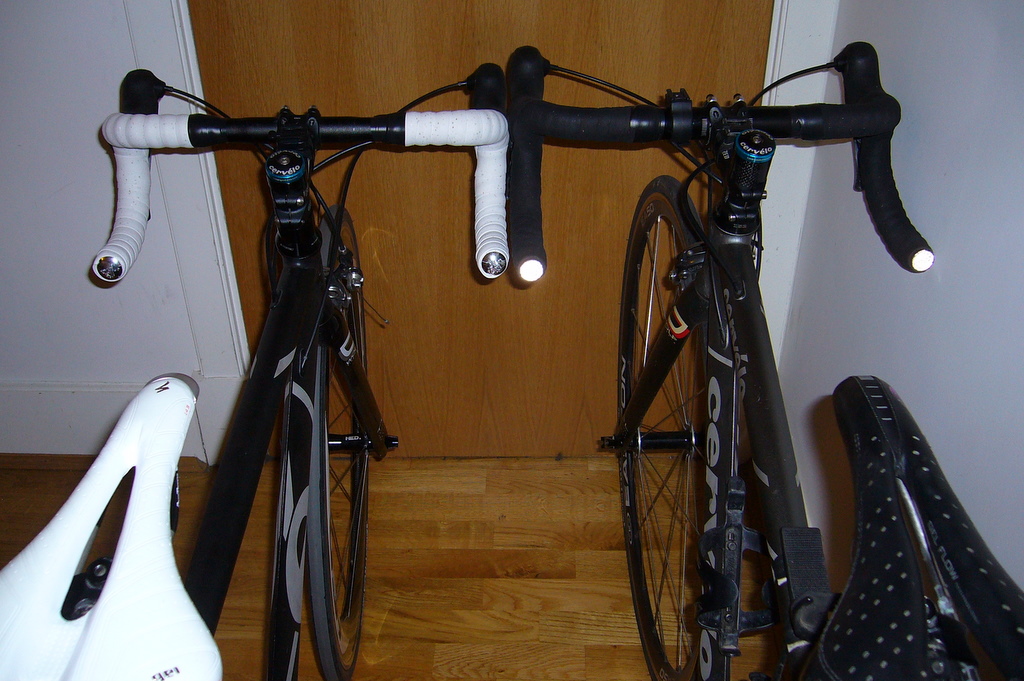
Here's what my two bikes looked superimposed on each other. Notice the steeper seattube on the P2SL (it is a TT frame after all), horizontal toptube and slightly slacker fork angle. I've still got some spacers under the stem which I'm hoping to remove over time so I can get even more low on the front end (the Soloist would need an lower-stack headset to get any lower). Both bikes have compact cranks, but the P2SL has an 11-23 cassette while the Soloist has a 12-27 for getting up those steep hills I train on but never seem to see much in races.
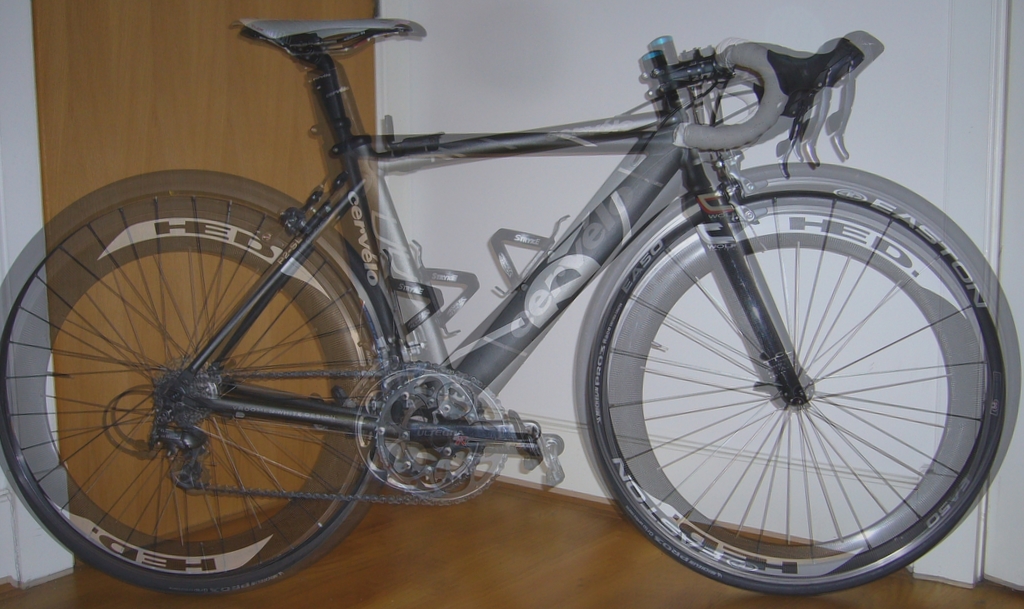 48cm Soloist (grey) vs 48cm P2SL (black)
The biggest difference I've found is the quicker acceleration with the smaller wheels, particularly on hills. There's also no toe overlap like I have on the Soloist (an unfortunate
side effect of proper geometry on a small frame with 700c wheels). I've since added 165mm cranks to the Soloist to try and improve both of those things, but I definitely notice a zippier and more frisky feel to the P2SL. At the same time, it seems to hit bumps harder and roll less happily over rough ground, which I attribute to the smaller wheel size (similarly to the way
29er mountain bikes are supposed to handle bumps more easily). Not sure if this is actually true or just my subjective feeling?
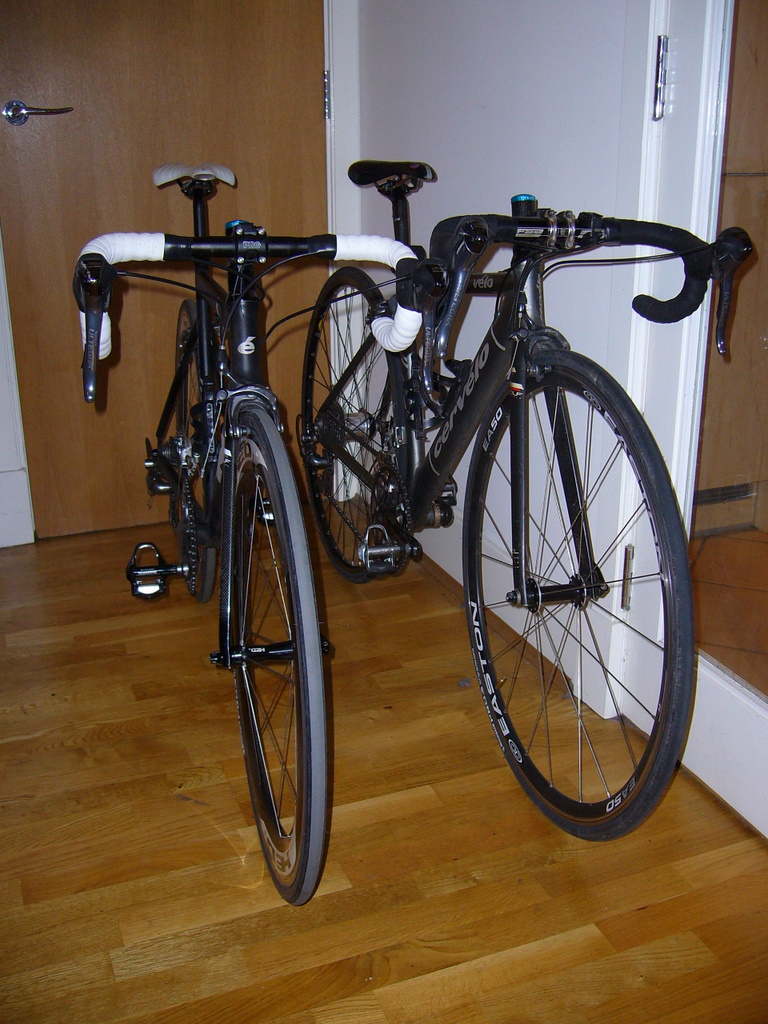
Some more pics of the P2SL alone and lined up against the Soloist: